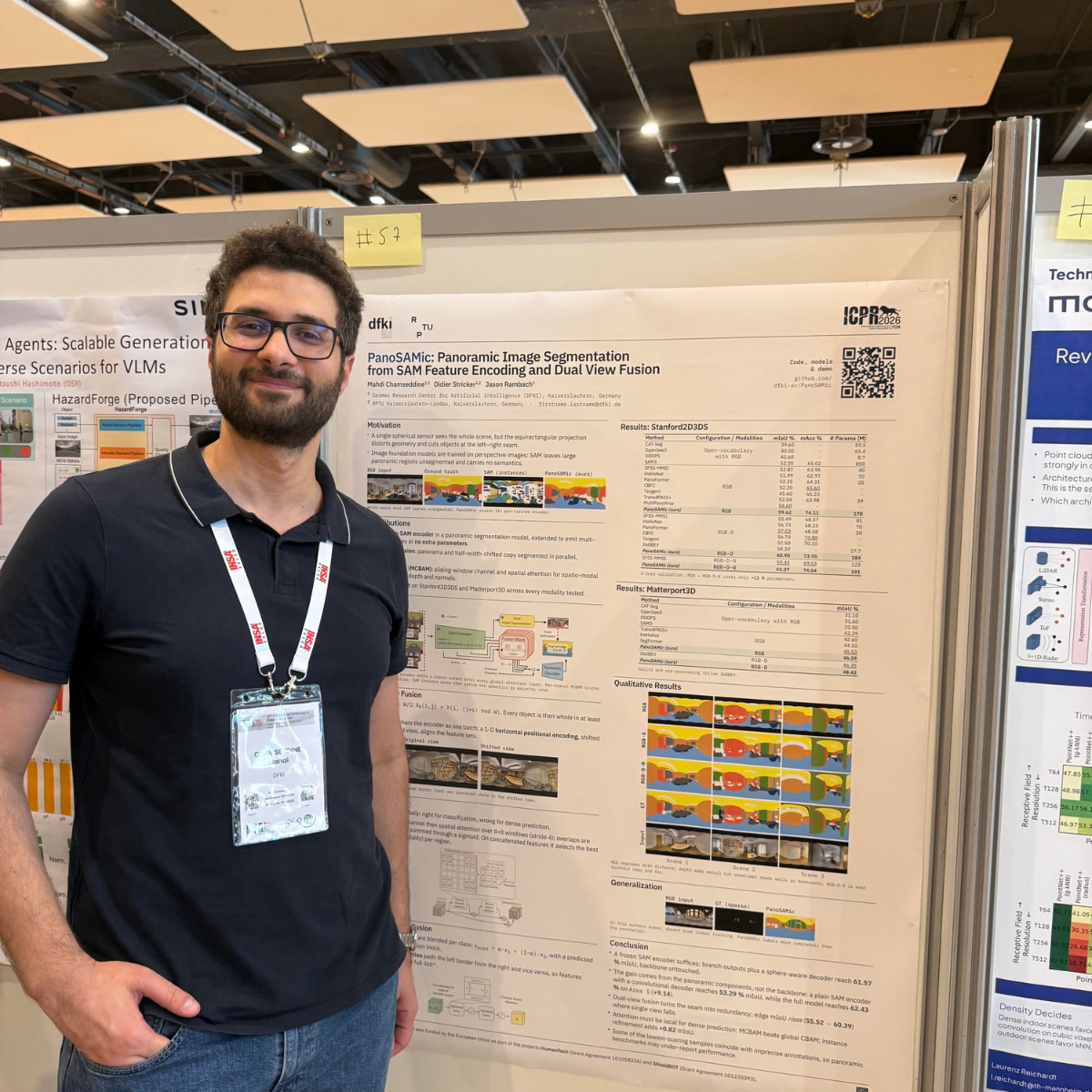
The ShieldBot project was represented at the 28th International Conference on Pattern Recognition (ICPR 2026), held from 17 to 22 August 2026 in Lyon, France, with a poster presentation by Mahdi Chamseddine, Researcher at the German Research Centre for Artificial Intelligence (DFKI), based on the paper “PanoSAMic: Panoramic Image Segmentation from SAM Feature Encoding and Dual View Fusion”.
This work is part of ShieldBot’s research activities in multi-sensor 3D perception and addresses the challenges of understanding panoramic imagery for robotics applications. Besides Mahdi, the paper is also co-authored by Didier Stricker from RPTU Kaiserslautern-Landau and Jason Rambach from DFKI.
Presenting PanoSAMic at ICPR 2026
On 19 August, Mahdi presented the PanoSAMic poster during Poster Session 3, as part of the Track 2 – Vision And Language & Visual Perception From 3D Point Clouds.
PanoSAMic explores how foundation models such as the Segment Anything Model (SAM) can be adapted for panoramic, or 360-degree, image understanding. Existing image foundation models are primarily trained on perspective images and therefore face challenges when dealing with the distortions and discontinuities characteristic of spherical imagery. PanoSAMic addresses these challenges by adapting the SAM encoder to provide multi-stage features and introducing a spatio-modal fusion approach to select relevant features and modalities for different regions of an image. Its semantic decoder further combines spherical attention and dual-view fusion to improve segmentation of panoramic scenes.
The conference paper and the poster are openly available on ShieldBot’s Zenodo.
More about ICPR 2026: The 28th International Conference on Pattern Recognition
The International Conference on Pattern Recognition (ICPR 2026) brought together researchers from across computer vision, machine learning, image processing, speech and natural language processing and sensor pattern processing, providing an important forum for exchanging ideas and fostering new collaborations. As Mahdi summarised, the conference offered “publicity through the work published and discussions with peers.”
This exchange is particularly valuable for ShieldBot, where advances in perception and scene understanding form an important foundation for developing robotic technologies for sustainable and efficient thermal shielding of buildings.