Month: November 2025

European Project ShieldBot Kicks Off to Pioneer Sustainable Robotics in Construction

The ShieldBot project – Next-Generation Robotics for Sustainable and Efficient Thermal Shielding of Buildings – officially launched with a kick-off meeting on 4-5 of November 2025 at the premises of IDEKO Research Centre, the project coordinator, in Elgoibar (Basque Country), Spain.

Funded by the Horizon Europe programme with EUR 4 million and set to run over three years, ShieldBot brings together 11 partners from six European countries. The consortium ambitions to revolutionise how buildings are constructed, renovated, and maintained through the use of advanced, sustainable robotics.

In response to Europe’s growing demand for energy-efficient and sustainable buildings, ShieldBot aims to bridge the gap between traditional construction methods and modern sustainability standards. The project will develop and validate a new generation of robotic systems specifically designed for the construction, renovation, and maintenance of buildings, enabling greater efficiency, safety, and environmental performance.

At its core, ShieldBot focuses on three key robotic platforms: InnerShieldBot, designed for internal construction work to enhance the thermal performance of walls and ceilings; InspectionShieldBot, equipped with advanced sensors to assess exteriors, identify structural or insulation needs, and ensure long-term building integrity, and FaçadeShieldBot, which installs thermal shielding on building façades to improve insulation and reduce energy consumption.

These robotic systems are supported by DigiShield, a digital twin platform that aggregates and analyses data from on-site operations, enabling real-time decision-making and precise project planning. Moreover, the use of EcoShield materials, innovative, eco-friendly insulation solutions, will further minimise the carbon footprint of construction activities.

“With ShieldBot, we are bringing smart robots into construction to help make buildings more sustainable and energy-efficient. By combining robotics with human expertise, we want to show how technology can work alongside people to make construction sites safer, greener, and more efficient. Our hope is that ShieldBot sets a new example for how robots and people can build a better future together”, explains Jokin Muñoa, Scientific Manager at IDEKO and Coordinator of ShieldBot.
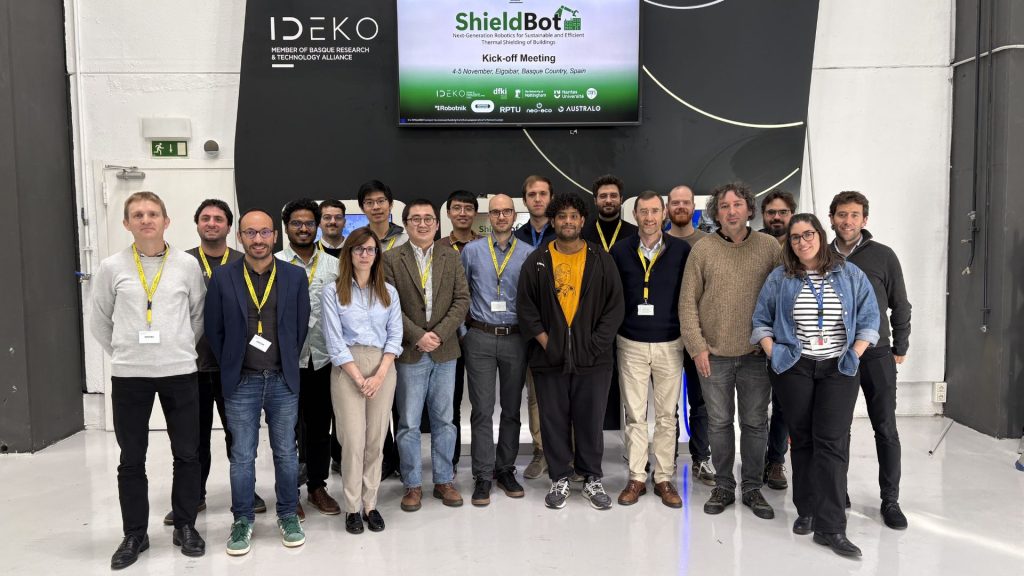
The ShieldBot partners at the kick-off meeting in IDEKO's facilities

Innovation through Collaboration

ShieldBot’s vision extends beyond automation. A strong emphasis is placed on human–robot collaboration, ensuring that technology complements human expertise rather than replacing it. This synergy will enhance workforce safety, productivity, and efficiency, while supporting the transition towards greener and smarter construction processes.

The project’s activities will be structured across three main research areas: disruptive robotic solutions for the construction industry, advanced robot functionalities for construction and renovation works, and advanced construction site technologies. In the context of these research areas, three demonstration cases will be carried out: interior wall and ceiling construction in office buildings, inspection and maintenance of exterior building façades, and exterior façade insulation of multi-family dwellings.

The ShieldBot consortium in charge of demonstrating the three use cases unites expertise from leading research institutions, universities, and industrial partners across Europe, coordinated by IDEKO (Spain). They are:  Deutsches Forschungszentrum für Künstliche Intelligenz GmbH - DFKI (Germany), University of Nottingham – Rolls-Royce UTC (UK), Nantes Université (France), CNRSLS2N Laboratory (France), Robotnik Automation SL (Spain), Bouygues Construction SA (France), Rheinland-Pfälzische Technische Universität - RPTU (Germany), Neo-Eco Development (France), Neo-Eco Ukraine LLC (Ukraine), and MTÜ AUSTRALO Alpha Lab (Estonia).

By combining cutting-edge robotics, artificial intelligence, and sustainable materials, ShieldBot will set a new benchmark for efficiency and environmental responsibility in construction. The project’s outcomes are expected to contribute significantly to the European Green Deal’s objectives and the broader digital and green transformation of the built environment.

You can also download this press release on ShieldBot's Zenodo.

Read More

The ShieldBot Partners Launch the Project in Elgoibar to Advance Robotics for Optimal Building Efficiency

On the 4th and 5th of November 2025, the ShieldBot consortium gathered in person for the first time at the facilities of IDEKO, our coordinator, in Elgoibar, a picturesque town in the Basque Country (Spain) to kick-off the project. ShieldBot, “Next-Generation Robotics for Sustainable and Efficient Thermal Shielding of Buildings”, is set to revolutionise the construction industry by integrating advanced robotics with sustainable practices to tackle some of the most pressing challenges in building renovation and energy efficiency.

As the demand for energy-efficient buildings continues to grow, traditional construction methods often struggle to keep pace with modern sustainability standards. ShieldBot bridges this gap with three of innovative robotic solutions:

  • InnerShieldBot applies internal thermal shielding to walls and ceilings, enhancing comfort and efficiency.
  • InspectionShieldBot employs advanced sensors to assess building exteriors, identifying areas requiring repair or insulation upgrades.
  • FaçadeShieldBot installs thermal shielding on façades to improve insulation and reduce energy consumption.

Complementing these systems, the DigiShield digital twin collects and analyses data from robot operations, enabling real-time decision-making and precise project planning, and the inclusion of EcoShield materials (eco-friendly, sustainable insulation options) further supports our mission to minimise the carbon footprint of modern construction. All under a human-robot collaboration approach, ensuring technology enhances, rather than replaces, human expertise, making on-site work safer, smarter, and more efficient.

The ShieldBot partners in the kick-off meeting in Elgoibar, Spain (November 2025)

The ShieldBot Consortium: 11 Partners from 6 European Countries

With 11 research and industrial partners from six European countries (including Ukraine and United Kingdom), the ShieldBot consortium is united by a shared vision to work together during the next three years: to set a new benchmark for sustainable construction and renovation, paving the way for a more efficient and environmentally responsible future in urban development.

Our kick-off meeting in Elgoibar started with a welcome and general project presentation led by Jokin Muñoa, Scientific Manager at IDEKO and ShieldBot Coordinator, in which he introduced ShieldBot and the robotic technologies that we will develop from Technology Readiness Level (TRL) 3 to TLR5, highlighting our objectives, activity areas and demonstrators. He also focused on the ShieldBot work distribution, including our work plan, gantt chart, milestones, deliverables and expected results.

After Jokin Muñoa, Miren Zelaia, Project Manager at IDEKO, explained the Work Package (WP) 1: 'Management and Coordination Activities', focusing on the financial statements and administrative management. This first part of our kick-off meeting finished with the introduction of our Project Officer from the European Commission, Rebecca Kanellea, Project Manager at CINEA, the European Climate, Infrastructure and Environment Executive Agency.

Then it was the turn for the ShieldBot partners, who introduced each of their organisations to present their background, expertise and activities: IDEKO, Deutsches Forschungszentrum für Künstliche Intelligenz (DFKI), Rolls-Royce UTC in Manufacturing and On-Wing Technology / University of Nottingham, Nantes Université, Laboratoire des Sciences du Numérique de Nantes (LS2N) / CNRS, Robotnik Automation, Bouygues Construction, RPTU Kaiserslautern-Landau, Neo-Eco, Neo-Eco Ukraine, and AUSTRALO.

The ShieldBot Work Packages

During the rest of the meeting, a discussion of each of our work packages was the central point of the agenda. We started with the WP2: 'Requirements and KPIs Definition', led by Bouygues Construction, followed by the WP3: 'Disruptive Robotic Solutions for Sustainable Built Environment', led by the University of Nottingham; the WP4: 'Advanced Robot Functionalities for Construction and Renovation', led by IDEKO; the WP5: 'Advanced Construction Site Technolgies', led by DFKI; the WP6: 'ShieldBot Demonstrators', led by Nantes Université, and last but not least, the WP7: 'Dissemination and Exploitation', managed by AUSTRALO.

But we not only presented each of our work packages, Bouygues Construction also hosted a workshop on WP2 in which all partners participated in a brainstorming session.

Jokin Muñoa, Scientific Manager at IDEKO and ShieldBot Coordinator, presenting the work plan and work packages relation

A Guided Tour of IDEKO, the ShieldBot Project Coordinator

The kick-off meeting is an inaugural gathering that formally launches a newly Horizon Europe funded project, in our case, ShieldBot, bringing together all members of the consortium for the first time in person.

This meeting provides an opportunity for partners to introduce themselves, begin building working relationships, and gain a clear understanding of each organisation’s role, responsibilities, and planned contributions. That is why during our kick-off, IDEKO offered us a guided tour around their facilities in Elgoibar to explain the research and innovation activities carried out there, specialised in advanced manufacturing technologies developed in four research groups: Dynamics and Control, Design and Precision Engineering, Information and Communication Technology (ICT) and Automation and Manufacturing Processes.

Read More

The ShieldBot project has received funding from the European Union’s Horizon Europe research and innovation programme under Grant Agreement No 101235093.
Views and opinions expressed are however those of the author(s) only and do not necessarily reflect those of the European Union or European Union’s Horizon Europe research and innovation programme. Neither the European Union nor the granting authority can be held responsible for them.

© SHIELDBOT. All rights reserved.