
Month: November 2026

Introducing the team behind ShieldBot: Meet UNOT
The University of Nottingham is a public research university based in Nottingham, United Kingdom. Founded in 1881 as University College Nottingham, it received its Royal Charter in 1948. Today, it is an internationally recognised institution with more than 40,000 students across its UK campuses and international campuses in Malaysia and China. Through its research and innovation activities, the University contributes to addressing major technological and societal challenges. Dr Xin Dong, Associate Professor at the University of Nottingham, specialises in the development of novel slender-arm and locomotion robots for challenging applications across sectors including aerospace, nuclear, construction, oil and gas, marine and rescue. Within SHIELDBOT, he leads the work on disruptive robotic solutions for a sustainable built environment and coordinates key activities related to robot architectures and functionality specifications, as well as the development of InspectionShieldBot and its application to the inspection and maintenance of exterior façades. ''The main objective of ShieldBot is to revolutionise the construction, renovation and maintenance sectors by developing and validating a new generation of robotic systems tailored to the industry’s unique challenges. We have a highly capable and reliable team at ShieldBot and it is always a pleasure to tackle ambitious long-term challenges with trusted partners.'' - Xin Dong, Associate Professor at the University of Nottingham. What does the University of Nottingham bring to the project? Could you describe your role in ShieldBot? The University of Nottingham has more than a decade of experience in developing continuum and soft robots for in-situ inspection and intervention of industrial infrastructure. We began with aerospace applications and are now exploring the potential of these technologies across other sectors. Building on our expertise in continuum, soft, and locomotion robots, we lead the development of ShieldBot hardware and related robotic inspection tasks. What expectations do you have for the project from your personal/organisational perspective? We aim to develop novel and practical robotic solutions to address challenges in the construction sector. By working with reliable EU partners across different areas of expertise, we hope to deliver well-considered solutions with real-world impact. Could you outline what you consider to be the three principal innovations that ShieldBot will develop over the course of the three-year project? ShieldBot will deliver three types of disruptive robotic systems tailored to the unique challenges of the construction sector. I’m keen to see how automation can reduce human error, address labour shortages and lower costs. What impact will ShieldBot have on industry and society in the short and long term? ShieldBot will enable safer and faster human–robot collaboration in construction and renovation. Its digital twin will collect, organise and analyse operational data from the robots, supporting real-time decision-making and precise planning. The project will also develop a novel sustainable insulation material, helping to reduce the carbon footprint of traditional building materials. How do you see the power of advanced robotics and sustainable practices transforming the European construction and energy building efficiency sector? What benefits can it bring to science, economy and society? By combining cutting-edge technology with sustainability and efficiency, robots can set a new standard for construction and renovation. The technologies developed in ShieldBot could ease constraints on future building design arising from construction complexity, maintenance challenges, sustainability targets and budget limitations. They could also open new research directions in science and engineering and benefit other sectors facing similar challenges.
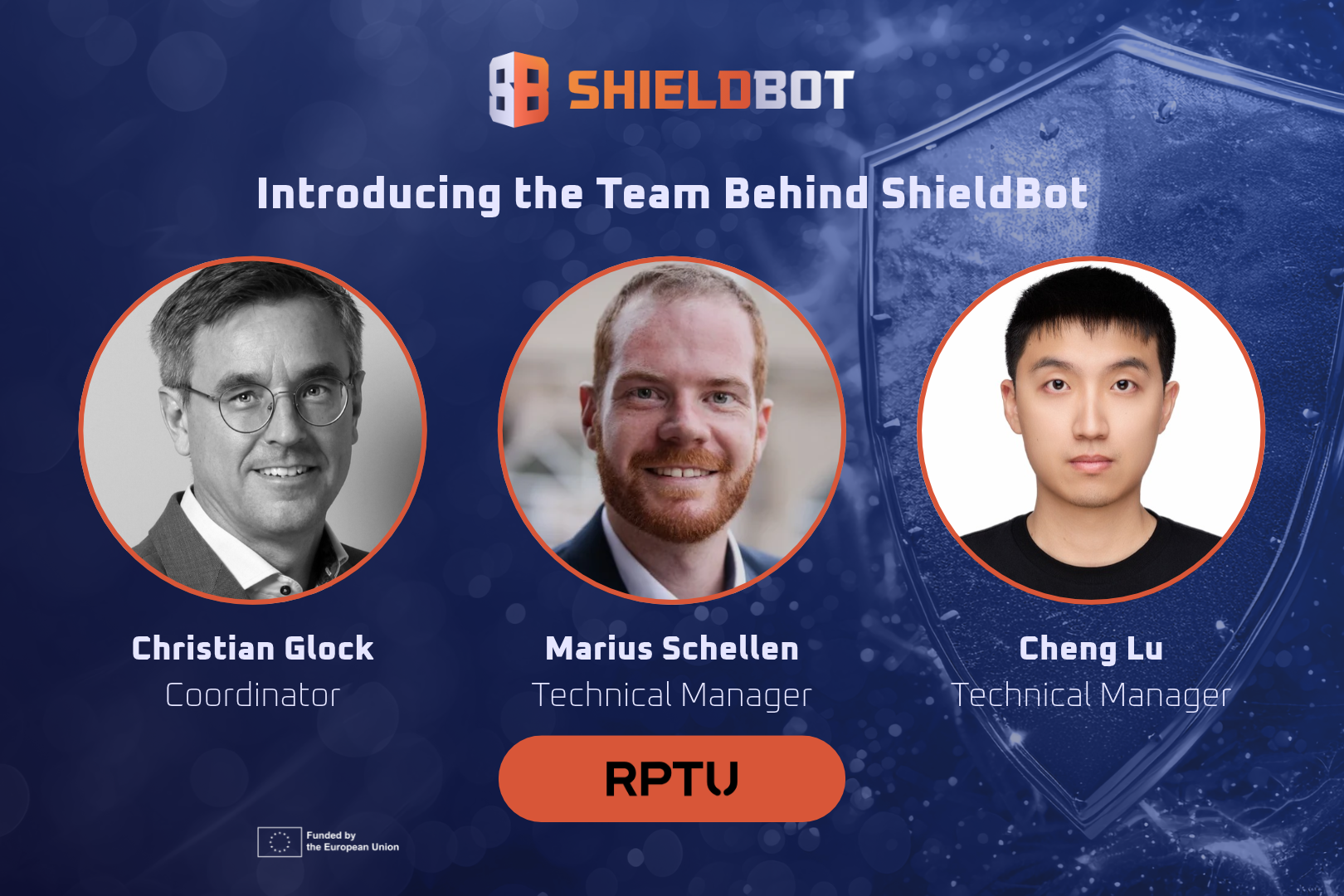
Introducing the team behind ShieldBot: Meet RPTU
RPTU is the Rheinland-Pfälzische Technische Universität, the only technical university in Rhineland-Palatinate, and a centre of international cutting-edge research and an academic talent factory for business and science. RPTU is also an innovation and transfer partner for politics, business and society. Prof. Dr.-Ing. Christian Glock, Professor of Concrete Structures and Structural Design at RPTU Kaiserslautern-Landau, Civil Engineer, formerly Managing Director and Executive Vice President at Bilfinger SE; Marius Schellen, M.Sc., Research Associate at the Institute of Concrete Structures and Structural Design, Civil Engineer; and Cheng Lu, M.Sc., Research Associate at the Institute of Concrete Structures and Structural Design, Civil Engineer. They work together at RPTU, and their main role within ShieldBot is to lead task T5.2, “Digital twin and dynamic BIM integration”, together with Deutsches Forschungszentrum für Künstliche Intelligenz (DFKI). We are thrilled to be part of such a motivated and innovative consortium. Joining ShieldBot gives us a wonderful opportunity to take our research on digital BIM tools and structural engineering to a European level. While we have strong roots in the German construction sector, we really value the chance to look beyond our borders. It is incredibly important to us to expand our network and collaborate with inspiring researchers and fantastic facilities across Europe. Why did you join ShieldBot? Joining ShieldBot gave us a wonderful opportunity to take our research on digital BIM tools and structural engineering to a European level. While we have strong roots in the German construction sector, we really value the chance to look beyond our borders. Expanding our network and collaborating with inspiring researchers and excellent facilities across Europe is incredibly important to us. What does RPTU bring to the project? Could you describe your role in ShieldBot? For the development of our DigiShield solution, we are bringing a strong foundation to the ShieldBot project. We are contributing the intellectual property of a functional Scan-to-BIM pipeline, which we developed alongside DFKI in a previous collaboration within the HumanTech EU project. Right now, this system is focused on creating semantically enriched geometry models. Beyond this technical piece, we are excited to integrate our deep domain knowledge and our extensive network of German construction stakeholders. We can also provide a great mix of design and construction expertise that bridges long-term engineering practice with state-of-the-art research and top-tier laboratory facilities. What expectations do you have for the project from your personal/organisational perspective? Throughout this project, we really want to push our Scan to BIM pipeline further. Our goal is to integrate data from multiple sensors so we can automatically upgrade the building model into a true digital twin representation of existing structures. This developed model can then serve as the perfect foundation for automated robotic orchestration and orientation. We are also looking forward to working closely with DFKI again to enrich this pipeline with advanced AI tools. We are also genuinely excited to support the development of on-site construction robotics with our domain-specific insights. For us, this is a fantastic opportunity to learn from our partners across Europe and to share these experiences with our German interdisciplinary research initiative “Building the Future”, which we are proud to lead. Could you outline what you consider to be the three principal innovations that ShieldBot will develop over the course of the three-year project? For us, the most exciting innovations in the overall ShieldBot project are creating a fully integrated Scan to BIM pipeline. This will feature intuitive graphical interfaces and process data from multiple sensors via the InspectionShieldBot alongside smart AI orchestration for robotic tasks. Seeing the cable-driven FaçadeShieldBot in action and watching multiple robots work together seamlessly within the InnerShieldBot will be absolute highlights. These breakthroughs are exactly what is needed to bridge the gap between today's manual processes and the automated future of construction. What impact will ShieldBot have on industry and society in the short and long term? In the short term, the ShieldBot solutions will likely have a moderate impact on the industry, as the expected Technology Readiness Level is still relatively low for the construction sector. However, we see ShieldBot as a vital project that establishes the foundational technology needed to scale up in the long run. With these solutions, the European construction sector will ultimately become more efficient, faster, safer, and more environmentally friendly. How do you see the power of advanced robotics and sustainable practices transforming the European construction and energy building efficiency sector? What benefits can it bring to science, economy and society? As one of the largest industries globally, the construction sector has a massive impact on our ecosystem, emissions and energy consumption. By integrating advanced robotic solutions with smart models of existing buildings, we have the opportunity to truly revolutionise the way we build. This approach will significantly lower emissions and resource consumption by focusing on revitalising existing structures instead of demolishing them to start from scratch. Furthermore, in a labour market facing a growing shortage of skilled workers, automated robotics can ease key bottlenecks and help deliver much-needed affordable housing across Europe.
One Year of ShieldBot: Meetings, Conferences and New Allies for Robotics in Construction
In October 2026, we completed our first year of work, having met in France, Germany and Spain to review progress and plan the next phase, presented our research at international conferences, and joined forces with our Tech4EUConstruction cluster partners and sibling projects at European events. Discover ShieldBot Our Demo Cases ShieldBot will validate its robotic solutions in three demo cases covering construction, renovation and maintenance: Interior wall and ceiling construction in office buildings, with InnerShieldBot: dual robotic arms and a continuum robot that handle, fix and insulate panels, guided by LiDAR and a BIM-based digital twin. Inspection and maintenance of exterior building façades, with the InspectionShieldBot: a drone combined with a crawling robot that uses non-destructive testing sensors to detect hidden defects without scaffolding or cranes. Exterior façade insulation of multi-family dwellings, with the FaçadeShieldBot: a cable-driven parallel robot that installs prefabricated, bio-based insulation panels, integrated with the DigiShield digital twin. Discover our demo cases Our Methodology ShieldBot aims to take early-stage robotic technologies through three pillars: disruptive robotic solutions (InnerShieldBot, InspectionShieldBot, and FaçadeShieldBot), advanced construction site technologies (EcoShield innovative eco-materials and DigiShield digital twin with dynamic BIM and AI-based task orchestration), and advanced robot functionalities (robotic perception, advanced control, and human–robot interaction). Explore our methodology ShieldBot in Action: Consortium Meetings The ShieldBot Team Meets in France for the Project’s Second General Assembly Hosted by Bouygues Construction On 6–7 May 2026, Bouygues Construction hosted the consortium in Guyancourt and Neuilly-sur-Seine for ShieldBot’s second General Assembly. Partners reviewed technical and management progress and marked the completion of WP2 “Requirements and KPIs definition”, led by Bouygues. On the second day, the team visited the Les Arches du Carreau renovation site, where DFKI and RPTU researchers scanned a construction area for the project. Catch up on the General Assembly ShieldBot Work Package Leaders Meet in Kaiserslautern to Shape the Next Project Phase On 2 July 2026, the work package leaders met at DFKI in Kaiserslautern, Germany, hosted by Jason Rambach. Partners reviewed progress across the work packages, the industry requirements, and the KPIs, and held technical sessions on the three robots. Highlights included a crawling façade-inspection robot demonstrated by the University of Nottingham, an experimental testing platform from Nantes Université and CNRS, and Scan-to-BIM results from DFKI and RPTU. Read the full article ShieldBot Consortium Meets in Valencia for the Project’s First Year Hosted by Robotnik On 13–14 October 2026, Robotnik Automation welcomed the consortium to Valencia, Spain, to review ShieldBot's first 12 months' key achievements. Partners reviewed the first-year advances, shared updates on the three robotic demonstrators, held a session on robot perception and human–robot interaction, and set priorities for the second year, which starts in November 2026. Read the full article ShieldBot at Conferences and Events Our partners presented ShieldBot research to the scientific and industrial communities in metrology, computer vision and digital construction. ShieldBot Participates in the 3DMC 2026 Metrology Webinar On 8 May 2026, Oier Saez de Egilaz (IDEKO) took part in the 3DMC 2026 webinar “Previewing the Latest Advances in 3D Metrology”, previewing ShieldBot research on uncertainty-aware close-range photogrammetry design ahead of the conference in September. The recording is available on ShieldBot’s Zenodo community. Read the main highlights DFKI Presents the ShieldBot Scan-to-BIM Pipeline at the European Conference on Computing in Construction 2026 At EC3 2026 in Corfu, Greece (12–15 July 2026), Mahdi Chamseddine (DFKI) presented BIMStruct3D, a paper co-authored by DFKI and RPTU researchers. The work describes a hybrid pipeline that combines learning-based semantic segmentation with topology-aware reconstruction to generate IFC-compliant BIM models from 3D point clouds. Read the main highlights ShieldBot at the International Conference on Pattern Recognition: Advancing Panoramic Perception for Robotics At ICPR 2026 in Lyon, France (17–22 August 2026), Mahdi Chamseddine (DFKI) presented the poster “PanoSAMic: Panoramic Image Segmentation from SAM Feature Encoding and Dual View Fusion”, co-authored with Didier Stricker (RPTU) and Jason Rambach (DFKI). The work adapts the Segment Anything Model to 360-degree images and supports ShieldBot’s multi-sensor 3D perception research. Read the main highlights IDEKO Presents ShieldBot Research on Photogrammetry Design at the 3D Metrology Conference 2026 At 3DMC 2026 at Loughborough University London (8–10 September 2026), Oier Saez de Egilaz (IDEKO) presented the paper “Uncertainty-Aware Photogrammetry Design: 2D Subpixel Measurement Accuracy and Precision Modelling” to around 60 attendees from research and industry. The work addresses measurement uncertainty in marker-based photogrammetry, which is key to reliable and precise robotic perception. Read the main highlights ShieldBot Showcases Construction 5.0 Innovations at IC2 2026 with the EU-funded Projects RADIANCE and RoboCons At the Innovation Industry Construction Congress (IC2 2026) in Santander, Spain (1–5 June 2026), ShieldBot, RADIANCE and RoboCons joined the session “Construction 5.0: Optimising Value Chain Processes for Enhanced Productivity and New Business Models”. ShieldBot was represented by Iker Mancisidor Aizpurua (IDEKO). Read the event chronicle The Tech4EUConstruction Cluster Advancing AI and Robotics in Construction Together The Tech4EUConstruction Cluster aims to develop and demonstrate new technologies to further digitalise and automate the European construction sector, making it safer and more attractive for workers. During this period, the cluster welcomed two new active projects: RADIANCE and RoboCons, sibling Horizon Europe projects to ShieldBot, working towards a safer, smarter, and more sustainable construction industry supported by advanced robotics, artificial intelligence (AI), and intelligent automation. Other cluster projects, such as DTERBIM, develop an innovative design and project delivery methodology for more efficient and circular construction, and DISCOVER develops an autonomous system to identify and analyse materials in end-of-life buildings. Read how RADIANCE, RoboCons and ShieldBot can transform Europe’s construction industry Together, we have taken part in two events: ShieldBot at the AI Data Robotics Forum 2026: Workshop on AI, Data and Robotics for Construction 5.0 On 14 October 2026, at ADRF26 in Porto, Portugal, the cluster organised the workshop “AI, Data and Robotics for Construction 5.0: From European Pilots to Industrial Deployment”. ShieldBot, DISCOVER, RADIANCE and RoboCons presented their robotic approaches and discussed how to move results from pilots to industry. Juanan Arrieta represented ShieldBot on behalf of IDEKO. Read the chronicle IDEKO Represents ShieldBot at the Built4People Clustering Event On 6 October 2026, Iker Mancisidor Aizpurua (IDEKO) represented ShieldBot at the Built4People Projects Clustering Event, alongside DTERBIM, RADIANCE and RoboCons from the Tech4EUConstruction cluster. The event began with a CINEA cluster meeting on collaboration between projects and continued with the B4P Stakeholders Forum on resilience, digitalisation and the adoption of robotics. Read the chronicle Who is behind ShieldBot? Through our Introducing the Team campaign, we are presenting the people and organisations behind ShieldBot. So far, five partners have shared who they are and what they bring to the project: IDEKO (Spain), the project coordinator, brings sensing and advanced control capabilities to ShieldBot’s robots. With Jokin Muñoa and Iker Mancisidor. Meet IDEKO DFKI (Germany), ShieldBot’s main partner for AI and computer vision and leader of WP5 “Advanced Construction Site Technologies”. With Jason Rambach and his team. Meet DFKI Nantes Université (France)brings expertise in cable-driven parallel robots and leads WP6 and the development of the FaçadeShieldBot. With Kevin Subrin. Meet Nantes Université Robotnik (Spain) contributes its RB-ROBOUT mobile platform and ROS-based navigation software, adapted for indoor use. With Marc Bosch. Meet Robotnik RPTU (Germany) contributes a Scan-to-BIM pipeline to DigiShield and co-leads the digital twin and dynamic BIM integration with DFKI. With Christian Glock, Marius Schellen and Cheng Lu. Meet RPTU Thank you for reading the second ShieldBot Newsletter! We encourage you to follow our journey to revolutionise the EU construction industry with robotics. – To discover more about ShieldBot, subscribe to our newsletter, and follow us on LinkedIn, BlueSky and YouTube! You can also check our Privacy Policy.