
Interviews
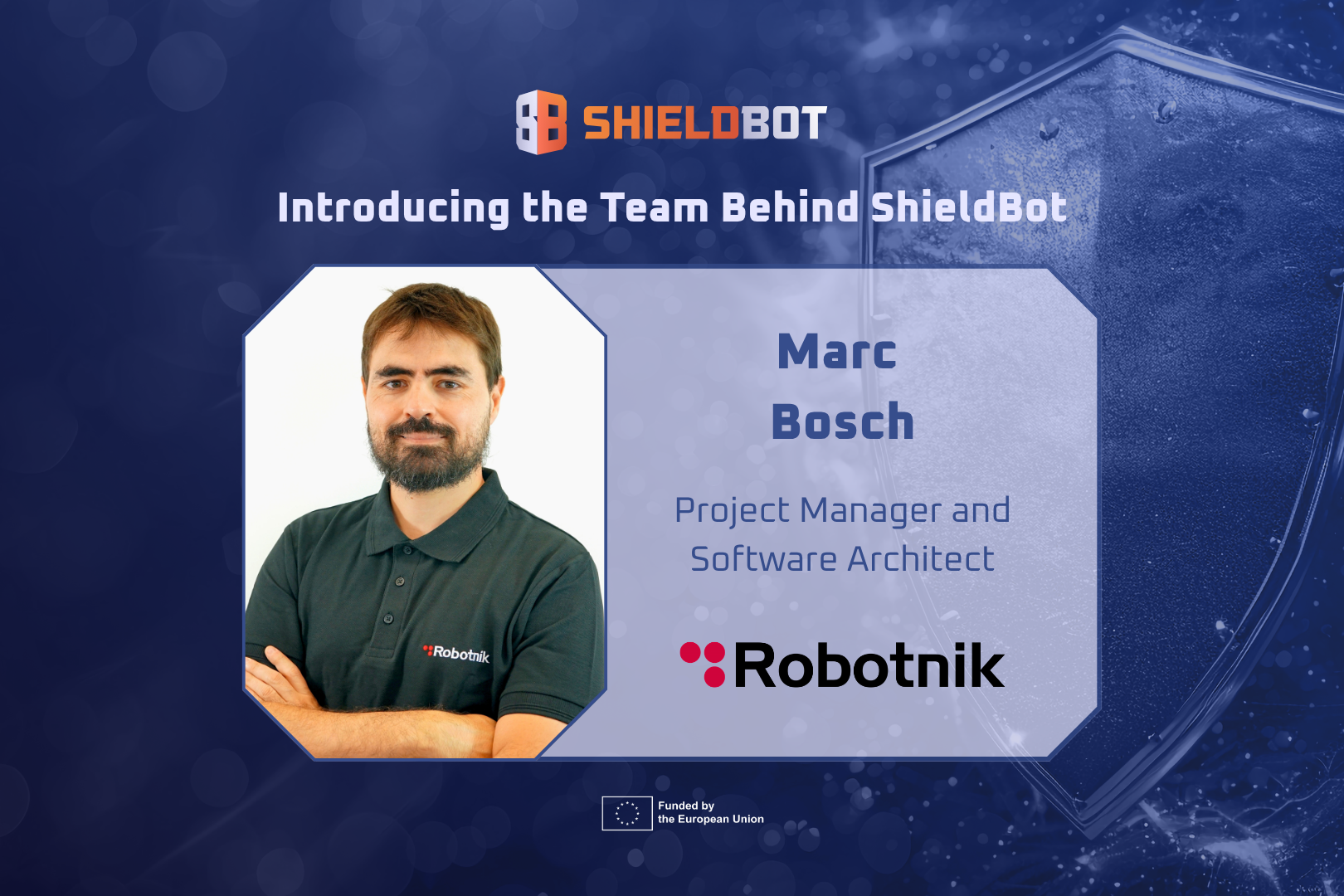
Introducing the team behind ShieldBot: Meet Robotnik
Robotnik Automation is an innovative Spanish SME specialising in mobile service robotics, focused on mobile robot platform development and manufacturing, and mobile service robotics R&D and engineering projects. They are certified in the design, manufacturing, and commercialisation of products and systems based on robotics technology, as well as in R&D management for developing robotics projects.
Marc Bosch is a Project Manager and Software Architect at Robotnik, with a background in mobile robotics software engineering. At ShieldBot, he leads the task responsible for mobile platform development, focusing on adapting our platform for indoor applications.
''Robotnik brings its RB-ROBOUT mobile platform and advanced ROS-based navigation software designed to operate safely in dynamic construction sites. My role is to lead the development and adaptation of this mobile base to integrate seamlessly with the manipulation payload.'' - Marc Bosch, Project Manager and Software Architect at Robotnik.
Why did you join ShieldBot?
I joined ShieldBot to help bring mobile robotics into the construction sector, an industry that has traditionally lacked automation. It is a great opportunity to evolve our RB-ROBOUT platform in real renovation environments alongside a leading European consortium.
What does Robotnik bring to the project? Could you describe your role in ShieldBot?
Robotnik brings its RB-ROBOUT mobile platform and advanced ROS-based navigation software designed to operate safely in dynamic construction sites. My role is to lead the development and adaptation of this mobile base to integrate seamlessly with the manipulation payload.
What expectations do you have for the project from your personal/organisational perspective?
From an organizational standpoint, we aim to validate a robust, market-ready mobile platform capable of automating key tasks in building renovation. Personally, I expect to demonstrate that dynamic indoor navigation can be deployed safely and effectively in harsh construction conditions.
Could you outline what you consider the three principal innovations ShieldBot will develop over the three-year project?
The primary innovation is introducing mobile automation into heavy, hazardous construction tasks that are traditionally performed manually. Additionally, it combines a modular family of specialized robots with real-time digital twin monitoring and safe human-robot interaction on-site.
What impact will ShieldBot have on industry and society in the short and long term?
In the short term, it will reduce physical strain and risks for construction workers while accelerating renovation processes. In the long term, it will drive the digital and automated transformation of the sector, making building maintenance and insulation more efficient and accessible.
How do you see advanced robotics and sustainable practices transforming the European construction and energy building efficiency sector? What benefits can it bring to science, economy and society?
Combining robotics with sustainable practices addresses critical labour shortages and improves working conditions across European job sites. Economically and socially, it leads to faster, safer building upgrades and helps accelerate Europe's overall decarbonization goals.
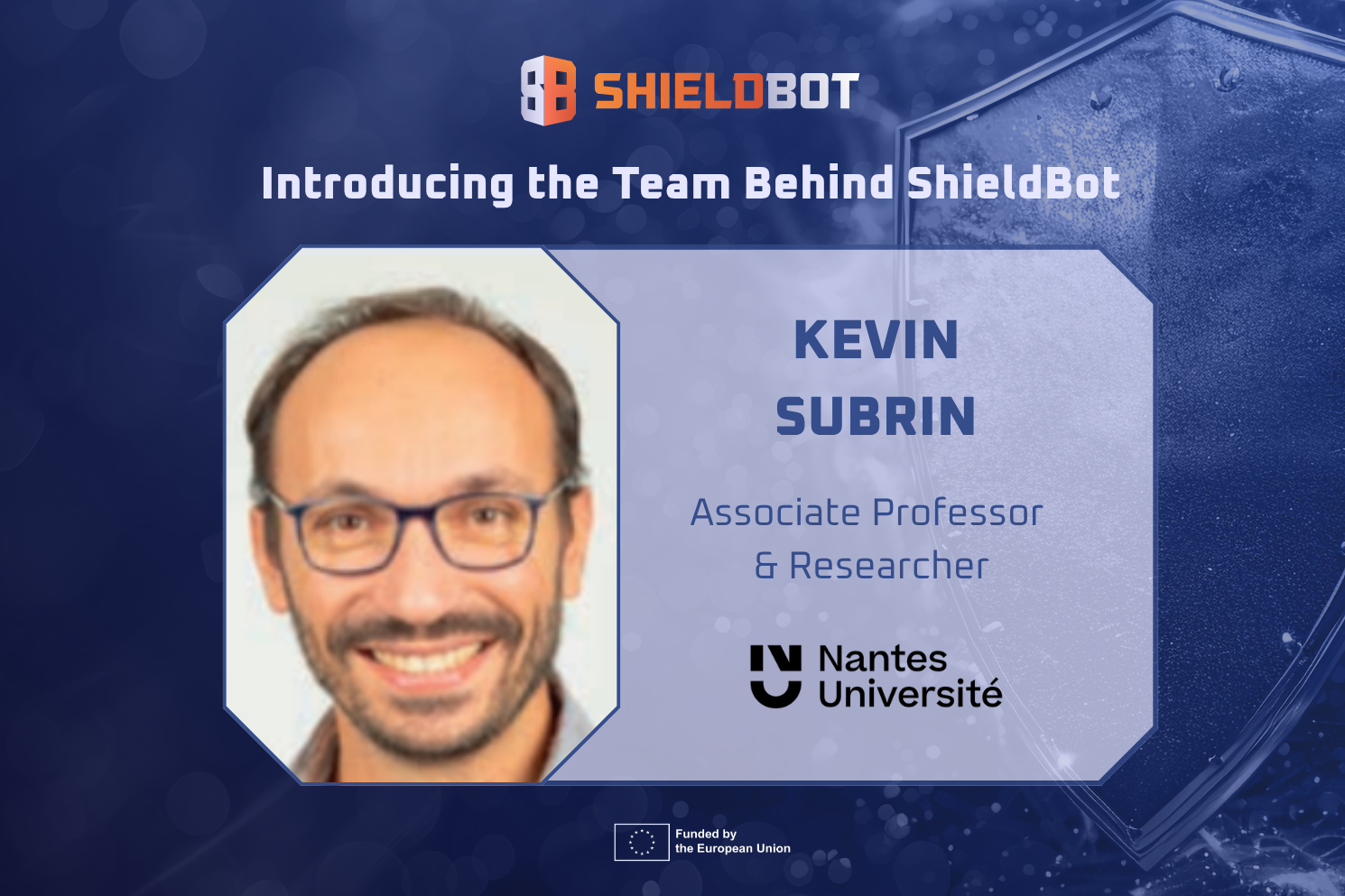
Introducing the Team Behind ShieldBot – Meet Nantes Université
Nantes Université is a French university that combines education and research across a wide range of fields, with around 42,000 students, 5,680 staff members, and 42 research laboratories. Its research spans fields from digital sciences and materials to thermal engineering and energy, and its international activity includes European research programmes and Erasmus+.
Kevin Subrin is an Associate Professor at Nantes Université. with his research activities conducted within LS2N. He holds an engineering degree in mechanical engineering and a PhD in industrial robotics.
Kevin’s work focuses on human-robot collaboration, with particular emphasis on improving robot performance. In ShieldBot, he leads Work Package 6, dedicated to prototype development. Within this work package, the team will develop the Façade ShieldBot, which will comprise two prototypes: a cable-driven parallel robot and an aerial cable-towed system combined with a cable-driven parallel robot, both intended to manipulate insulation panels on building façades.
''Nantes Université will bring its strong expertise in cable-driven parallel robots and, more recently, in aerial cable-towed systems. Insulation work on building façades often requires scaffolding, which is time-consuming to install and exposes workers to significant risks, including fatal falls.” Kevin Subrin, Associate Professor and Researcher at Nantes Université''
Why did you join ShieldBot?
Construction robotics is a key research area for our team. In 2017, we 3D-printed the Yhnova house, a project that subsequently led to the creation of Batiprint3D. In light of the scope of the call, our participation in this topic is highly relevant and particularly attractive to us.
What does Nantes Université bring to the project? Could you describe your role in ShieldBot?
Nantes Université will bring its strong expertise in cable-driven parallel robots and, more recently, in aerial cable-towed systems. Insulation work on building façades often requires scaffolding, which is time-consuming to install and exposes workers to significant risks, including fatal falls. Developing deployable robotic systems for façade insulation is therefore essential to improve safety on construction sites, support the renovation of buildings, and enhance indoor living conditions while addressing the challenges of the ecological transition.
What expectations do you have for the project from your personal/organisational perspective?
Our ambition is for the solution to be adopted by end users and successfully brought to market, thereby contributing to the acceleration of renovation.
Could you outline what you consider to be the three principal innovations that ShieldBot will develop over the course of the three-year project?
The project will deliver a set of robotic architectures capable of operating in both indoor and outdoor environments, as well as solutions to characterize the current energy performance of buildings. It will also provide key insights into how operators can be effectively integrated into the process, thereby supporting the acceptance and deployment of robotic solutions.
Which impact will ShieldBot have on industry and society in the short and long term?
In the short term, ShieldBot provides a credible pathway towards the ecological transition by supporting safer and more efficient building renovation. In the long term, ShieldBot will deliver a set of scalable robotic solutions that can accelerate the sustainable transformation of the construction sector.
How do you see the power of advanced robotics and sustainable practices transforming the European construction and energy building efficiency sector? What benefits can it bring to science, economy and society?
We need robust and accessible solutions that can benefit society as a whole. The world of tomorrow must aim for carbon neutrality and more controlled energy use, while relying on robotic systems to improve working conditions and support safer, more sustainable practices.
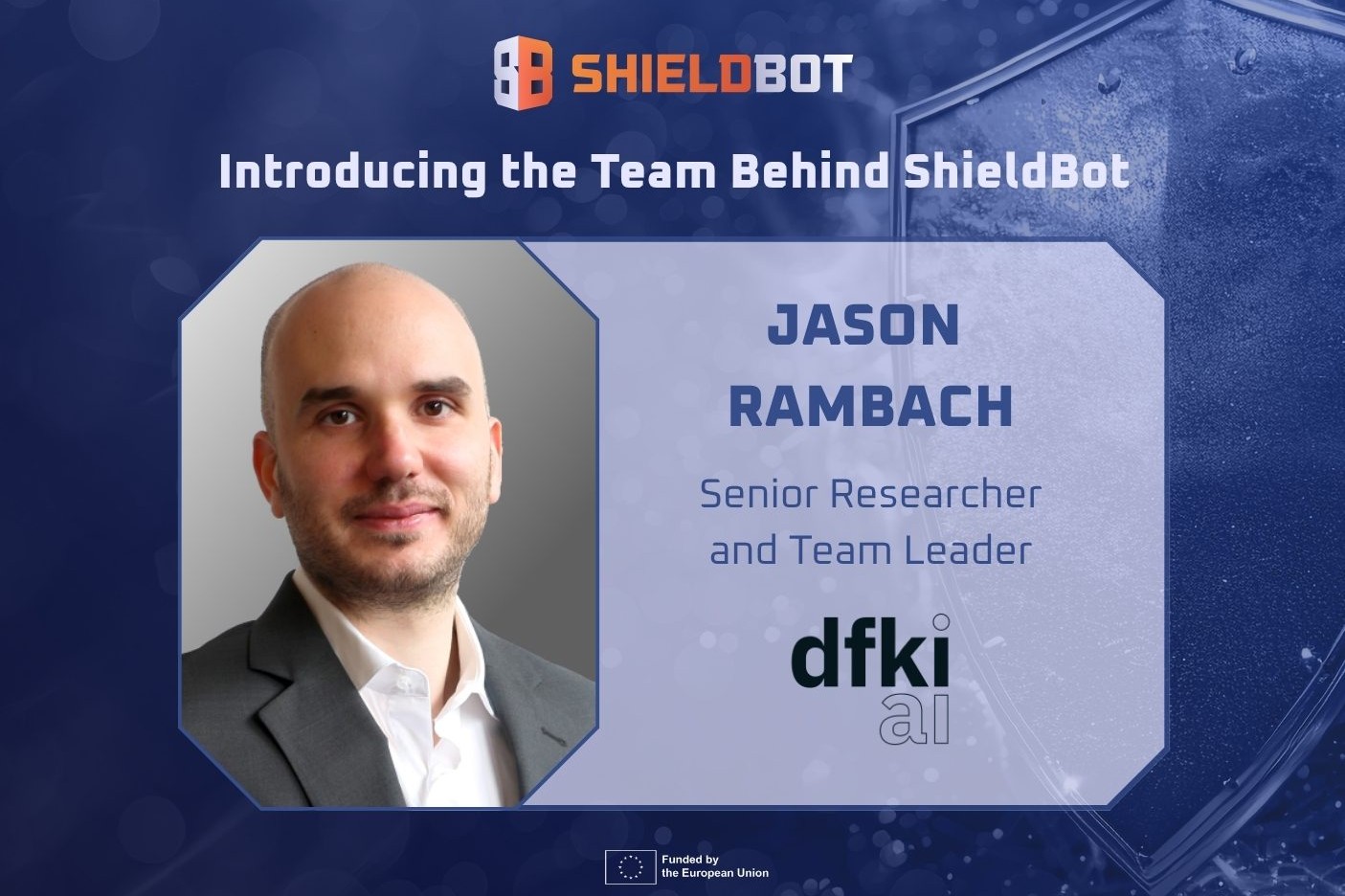
Introducing the Team Behind ShieldBot – Meet German Research Center for Artificial Intelligence (DFKI)
The German Research Center for Artificial Intelligence (Deutsches Forschungszentrum für Künstliche Intelligenz, DFKI) is one of Europe’s leading Artificial Intelligence (AI) research institutions. Founded in 1988 as a non-profit public-private partnership, DFKI conducts application-oriented research across a broad range of AI fields, with research departments and facilities across Germany and a strong focus on translating scientific advances into practical solutions for industry and society.
Jason Rambach is a Senior Researcher and Team Leader of the “Spatial Sensing and Machine Perception” group at DFKI. He also leads DFKI’s ShieldBot team, which includes Mahdi Chamseddine, Sandeep Prudhvi Krishna Inuganti and Sai Srinivas Jeevanandam.
Jason’s work focuses on AI-based Computer Vision, particularly on understanding and modelling the world from cameras and 3D sensors, as well as generating virtual worlds with AI. With a background in Computer Science and Electrical Engineering, his research interests centre on scene understanding and modelling from 3D data, especially open-vocabulary methods and object pose estimation. In ShieldBot, Jason and the DFKI team bring this expertise to the construction sector, where complex and dynamic environments present both opportunities and challenges for robotic perception. DFKI leads our Work Package 5, “Advanced Construction Site Technologies”, contributing its expertise in AI and perception to help enable smarter robotic solutions for construction.
"DFKI is the main partner bringing expertise on AI and Computer Vision to the project. We will transform unstructured 3D point clouds of scans into meaningful, semantically rich representations, while we'll help robots perceive their environment by turning sensor inputs into structured, actionable information." - Jason Rambach, Senior Researcher and Team Leader at DFKI.
Why did you join ShieldBot?
ShieldBot presented a set of very interesting and highly innovative robotic technologies (including soft robots, wall crawling robots and cable robots) as the main project targets along with a very clear role for us, very close to our core research interests: to provide the digital twin layer and BIM alignment for these robots. In this way, it was a great opportunity for us to continue work from previous projects such as HumanTech, on Scan-to-BIM and Open-vocabulary 3D segmentation.
On a more personal level, we were convinced by the direct and open approach of the coordinating team from IDEKO during the proposal preparation, and felt that ShieldBot was a worthy collaboration to pursue.
What does DFKI bring to the project? Could you describe your role in ShieldBot?
DFKI is the main partner bringing expertise on AI and Computer Vision to the project. Plainly, our role is in transforming unstructured 3D point clouds of scans into meaningful, semantically rich representations (extract objects and relations information from geometry data). We are also there to help robots perceive their environment by turning sensor inputs into structured, actionable information.
What expectations do you have for the project from your personal and also organisational perspective?
We are grateful for ShieldBot, because of the opportunity it gives us to advance our core-topics research while collaborating and learning from a strong consortium. Through this collaboration we expect to publish important new results and make more construction datasets available to the scientific community, while helping to solve important problems that the construction industry is facing today.
Could you outline what you consider to be the three principal innovations that ShieldBot will develop over the course of the three-year project?
This might be based more on personal taste, but three things that are capturing my interest right now in ShieldBot are:
- Completely new robot prototypes that are currently in development, such as the snake robot for interiors and the crawling robots for façade inspection.
- Our current work at DFKI makes Scan-to-BIM processes more accurate and scalable.
- The investigation of new eco-materials for sustainable construction seems very promising.
Which impact will ShieldBot have on industry and society in the short and long term?
In the short term, we are developing solutions that address real problems that the construction industry is facing today. For example, ShieldBot technologies have the potential of making building inspection faster, more accurate and less costly. ShieldBot also contributes to the safety of construction professionals, by assisting them in some of the most dangerous and uncomfortable tasks, related to façade work or ceiling paneling. In the long term, ShieldBot contributes to accelerating the much-needed renovation of ageing buildings in Europe as well as making the construction sector much more attractive to the young population, helping the sector to recruit new workers, one of the main challenges today.
How do you see the power of advanced robotics and sustainable practices transforming the European construction and energy building efficiency sector? What benefits can it bring to science, economy and society?
Robotics and AI have immense potential for the transformation of the construction industry. At the same time, the field remains very challenging for perception and navigation, human interaction, safety and resilience of robots, which means there is still a lot of work for us. Looking at the big picture, to unlock the full potential of construction robots, it is important that we start thinking beyond specialised single task robots and towards more generalised-capability robotic assistants for construction, in order to better align costs with advantages.
To summarise the scientific, economic and societal benefits, construction robotics:
- Present us with hard challenges that lead to state-of-the-art advancement.
- Can revolutionise and increase the efficiency of a critical sector, while offering opportunities to SMEs.
- Can make the sector more attractive and safer for workers.
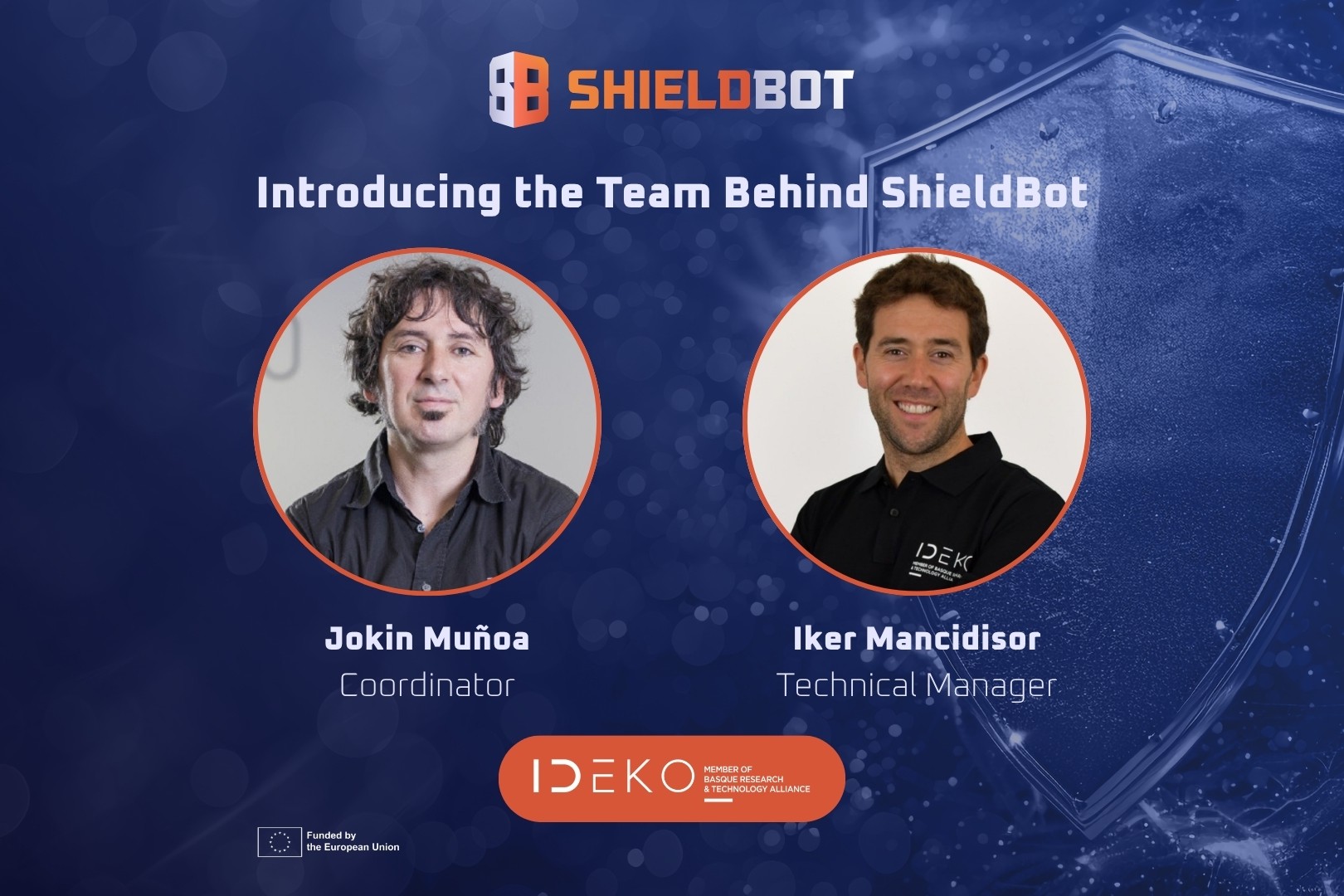
Introducing the Team Behind ShieldBot – Meet IDEKO Research Center
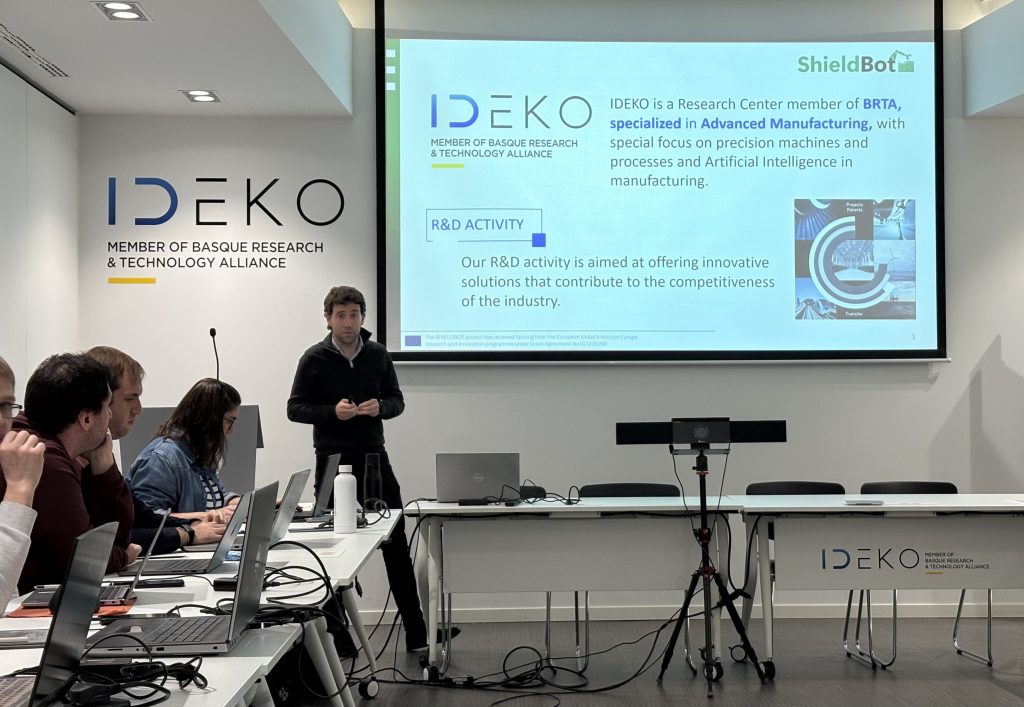
Jokin Muñoa and Iker Mancisidor work in the field of dynamics, control and advanced technologies for industrial applications at IDEKO Research Center, the ShieldBot project coordinator.
Jokin Muñoa is the Scientific Director of IDEKO and has led the Dynamics and Control research line since 2009. He holds a Ph.D. in Mechanical Engineering and has extensive experience in the field of manufacturing technologies, particularly in machine tool dynamics, vibration problems and advanced control solutions. Throughout his career, he has coordinated and participated in numerous European research projects and is also a Fellow Member of the International Academy for Production Engineering (CIRP). In ShieldBot, Jokin is the Project Coordinator, responsible for the overall coordination and for ensuring that the consortium works towards the common scientific, technological and industrial objectives of ShieldBot.
Iker Mancisidor is a Researcher on the Dynamics and Control research line at IDEKO, where he technically leads the Active & Smart Components specialisation line. He holds a Ph.D. in Mechanical Engineering and has more than 15 years of experience in machine tool dynamics, vibration control and the development of active and smart systems for industrial applications. He has participated in several European research projects and spent six months as a Postdoctoral Fellow at the Precision Controls Laboratory of the University of Waterloo in Canada. In ShieldBot, Iker acts as the Technical Manager of the project, supporting the coordination of the technical activities and the alignment of the developments carried out by the different partners and work packages.
"We believe that the technologies developed within ShieldBot can help make construction, renovation and maintenance activities safer for workers, while also improving productivity, quality and overall efficiency." - Jokin Muñoa, ShieldBot Coordinator, and Iker Mancidisor, ShieldBot Technical Manager, from IDEKO Research Center.
Could you briefly explain what ShieldBot is, in a nutshell?
ShieldBot is a European research project that aims to develop a new generation of integrated robotic solutions for the construction, renovation, inspection and maintenance of buildings. The project brings together expertise in robotics, artificial intelligence, sensing technologies, digitalisation and construction to address some of the main challenges faced by the sector. Our goal is to develop robotic systems that can operate in complex construction environments, support workers in physically demanding, repetitive or hazardous tasks, and improve the safety, efficiency and quality of construction and renovation processes. A key aspect of ShieldBot is that the technologies are developed around real industrial needs and use cases, with the ambition of bringing advanced robotics closer to practical application in the construction sector and contributing to its digitalisation and modernisation.
As the project coordinator, could you outline the reason behind the ShieldBot project? How was this idea born?
The idea behind ShieldBot emerged from IDEKO’s experience in recent years participating in several research projects focused on the development and application of robotic technologies in different industrial sectors. Through this work, we have seen that one of the greatest strengths of robotics is flexibility: robots can be adapted to different tasks and environments in a way that is much more difficult to achieve with conventional dedicated machines. This flexibility is opening the door to many new industrial applications.
At the same time, we saw that the construction sector faces several important challenges. The availability of skilled workers is decreasing, the workforce is ageing, productivity growth remains limited, and the adoption of new technologies and automation has generally progressed more slowly than in other industrial sectors. We therefore saw a clear opportunity to explore how the flexibility and adaptability offered by robotics could help address some of these challenges.
This was the starting point of ShieldBot. From there, we began bringing together partners with complementary expertise in robotics, artificial intelligence, sensing and digital technologies, as well as partners with strong knowledge of the construction sector and its real industrial needs. Each partner contributed its own experience, technological capabilities and ideas, progressively enriching the initial concept and helping us shape ShieldBot into the ambitious and multidisciplinary project it is today.
What does IDEKO bring to the project? Could you describe your role in ShieldBot?
IDEKO has two main roles in ShieldBot. First, as Project Coordinator, we are responsible for the overall management of the project, facilitating collaboration among the partners and ensuring that the different scientific and technological developments progress towards the common objectives of ShieldBot.
At the technical level, IDEKO leads the activities focused on providing the robotic systems with the sensing and advanced control capabilities required to perform construction tasks with greater precision, robustness and efficiency. Construction environments are complex and variable, and robots need to perceive their interaction with the environment and adapt their behavior accordingly. To address these challenges, we bring to ShieldBot our experience in mechatronics, sensing technologies, machine dynamics and advanced control strategies applied to both industrial machines and robotic systems. Our goal is to use this expertise to improve the performance of the ShieldBot robotic solutions and enable them to execute demanding construction tasks more accurately and reliably, helping to bridge the gap between advanced robotic technologies and their practical deployment in real construction applications.
What expectations do you have for the project from your personal and organisational perspective?
From both a personal and organisational perspective, we expect ShieldBot to demonstrate how advanced robotics can transform the way building construction, renovation and maintenance activities are carried out. Renovating building façades is often a challenging task that involves working at height, difficult access conditions and repetitive manual operations. We believe that the technologies developed within ShieldBot can help make these activities safer for workers, while also improving productivity, quality and overall efficiency.
From a technical point of view, we are particularly interested in the development of intelligent robotic systems capable of operating in complex and changing environments. The combination of robotics, artificial intelligence, sensing technologies and advanced control systems offers a unique opportunity to create solutions that can support inspection, maintenance and renovation tasks with a high level of autonomy and reliability. We expect the project to generate valuable knowledge in these areas and to push the current state of the art in construction robotics.
For IDEKO, ShieldBot is also an excellent opportunity to strengthen collaboration with leading European organisations from different sectors, combining expertise in robotics, digital technologies, construction and sustainability. By working together, we hope to develop solutions that go beyond the research stage and can eventually be adopted by industry. In the long term, we expect the project to contribute to safer working conditions, more energy-efficient buildings and a more sustainable construction sector across Europe.

Could you highlight what you consider to be the three principal innovations that ShieldBot will develop over the course of the three-year project?
We would highlight three main innovations that ShieldBot will develop during the project. The first one is the InnerShieldBot, a robotic system designed to support construction activities inside buildings. Its main focus will be the installation of plasterboard panels, helping workers carry out these demanding tasks more efficiently and with less physical effort. In addition, the platform will include an innovative snake robot capable of accessing confined and hard-to-reach spaces to spray insulation material.
The second innovation is the InspectionShieldBot, which will be dedicated to façade inspection and condition assessment. This solution will combine the capabilities of an aerial drone and a crawling robot that can move along building façades, providing detailed and complementary information about the condition of the building envelope. By integrating advanced sensors, imaging technologies and data analysis tools, the system will support earlier defect detection and more accurate planning of renovation activities.
The third innovation is the FaçadeShieldBot, an advanced robotic solution focused on the installation of insulation panels on building façades. The system will be based on a cable-driven robot capable of handling and positioning large insulation panels efficiently and safely on building exteriors. In addition, the project will investigate the possibility of combining this cable robot with aerial robotic platforms, exploring the use of drones to support and manipulate the system during installation operations. This innovative approach could offer greater flexibility, reduce manual work at height and enable safer and more efficient façade renovation processes.
Beyond the individual technologies, we believe the real strength of ShieldBot lies in its ambition to bring advanced robotics into different stages of a building’s life cycle. From construction and renovation activities to inspection and maintenance operations, the project will explore how robotic systems can support workers, improve safety and increase efficiency in tasks that are often physically demanding and difficult to automate. In addition, supporting developments such as DigiShield and EcoShield will help create the digital and sustainability frameworks needed to maximise the impact of these robotic solutions.
How do you see the power of advanced robotics and sustainable practices transforming the European construction and energy building efficiency sector? What benefits can it bring to science, economy and society?
We believe advanced robotics and sustainable practices can play a key role in the future of the European construction sector. Robotics can help workers perform demanding and potentially hazardous tasks more safely and efficiently, while sustainable renovation solutions can improve the energy performance of buildings and reduce their environmental impact.
More broadly, these technologies can help accelerate the transformation of the construction sector, making it more innovative, productive and sustainable. They can support the renovation of existing buildings, improve working conditions and contribute to reducing energy consumption. We are confident that these technologies will help create safer, greener, more comfortable and more affordable homes and buildings for people across Europe.