
Robotnik Automation is an innovative Spanish SME specialising in mobile service robotics, focused on mobile robot platform development and manufacturing, and mobile service robotics R&D and engineering projects. They are certified in the design, manufacturing, and commercialisation of products and systems based on robotics technology, as well as in R&D management for developing robotics projects.
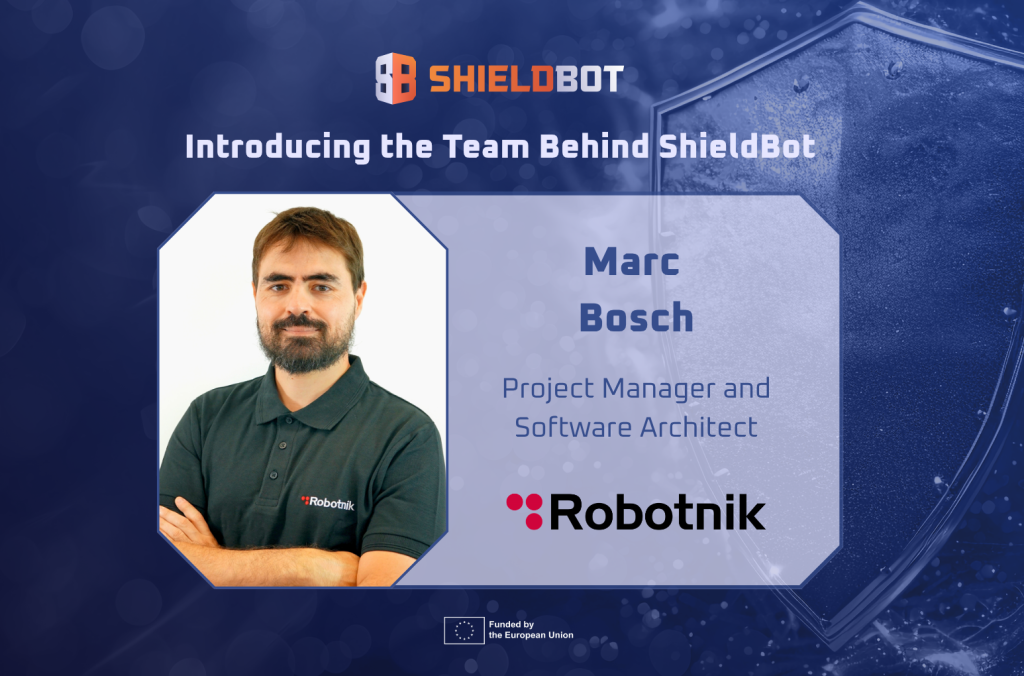
Marc Bosch is a Project Manager and Software Architect at Robotnik, with a background in mobile robotics software engineering. At ShieldBot, he leads the task responsible for mobile platform development, focusing on adapting our platform for indoor applications.
”Robotnik brings its RB-ROBOUT mobile platform and advanced ROS-based navigation software designed to operate safely in dynamic construction sites. My role is to lead the development and adaptation of this mobile base to integrate seamlessly with the manipulation payload.” – Marc Bosch, Project Manager and Software Architect at Robotnik.
Why did you join ShieldBot?
I joined ShieldBot to help bring mobile robotics into the construction sector, an industry that has traditionally lacked automation. It is a great opportunity to evolve our RB-ROBOUT platform in real renovation environments alongside a leading European consortium.
What does Robotnik bring to the project? Could you describe your role in ShieldBot?
Robotnik brings its RB-ROBOUT mobile platform and advanced ROS-based navigation software designed to operate safely in dynamic construction sites. My role is to lead the development and adaptation of this mobile base to integrate seamlessly with the manipulation payload.
What expectations do you have for the project from your personal/organisational perspective?
From an organizational standpoint, we aim to validate a robust, market-ready mobile platform capable of automating key tasks in building renovation. Personally, I expect to demonstrate that dynamic indoor navigation can be deployed safely and effectively in harsh construction conditions.
Could you outline what you consider the three principal innovations ShieldBot will develop over the three-year project?
The primary innovation is introducing mobile automation into heavy, hazardous construction tasks that are traditionally performed manually. Additionally, it combines a modular family of specialized robots with real-time digital twin monitoring and safe human-robot interaction on-site.
What impact will ShieldBot have on industry and society in the short and long term?
In the short term, it will reduce physical strain and risks for construction workers while accelerating renovation processes. In the long term, it will drive the digital and automated transformation of the sector, making building maintenance and insulation more efficient and accessible.
How do you see advanced robotics and sustainable practices transforming the European construction and energy building efficiency sector? What benefits can it bring to science, economy and society?
Combining robotics with sustainable practices addresses critical labour shortages and improves working conditions across European job sites. Economically and socially, it leads to faster, safer building upgrades and helps accelerate Europe’s overall decarbonization goals.