
The German Research Center for Artificial Intelligence (Deutsches Forschungszentrum für Künstliche Intelligenz, DFKI) is one of Europe’s leading Artificial Intelligence (AI) research institutions. Founded in 1988 as a non-profit public-private partnership, DFKI conducts application-oriented research across a broad range of AI fields, with research departments and facilities across Germany and a strong focus on translating scientific advances into practical solutions for industry and society.
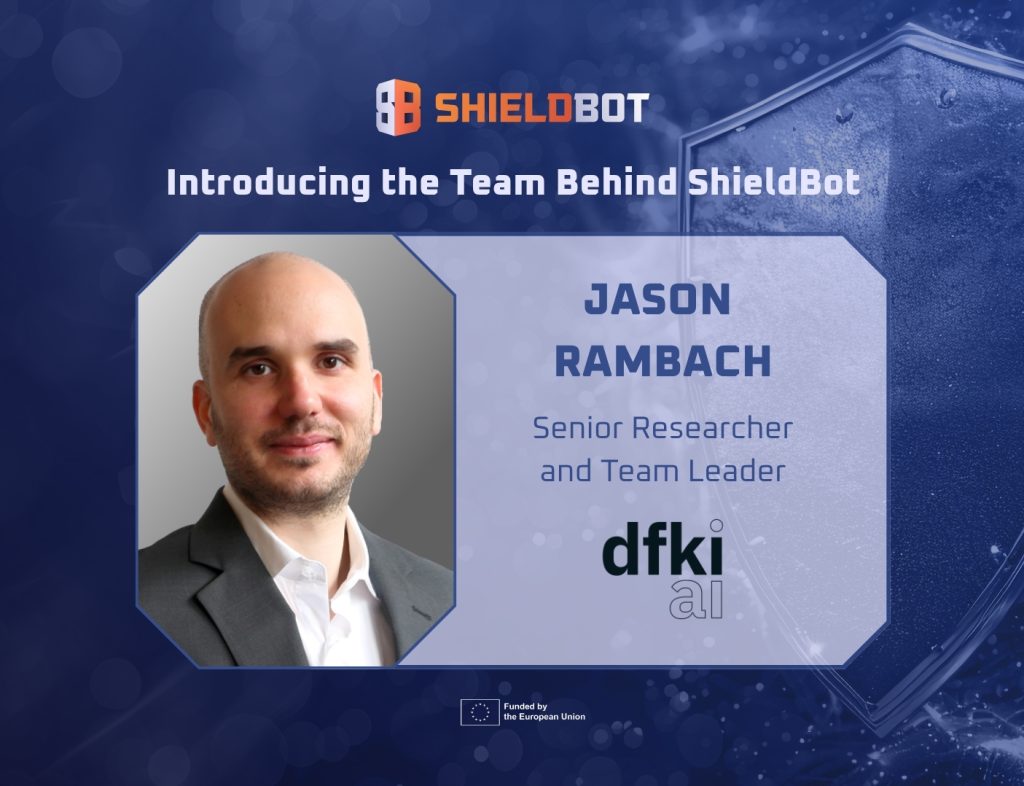
Jason Rambach is a Senior Researcher and Team Leader of the “Spatial Sensing and Machine Perception” group at DFKI. He also leads DFKI’s ShieldBot team, which includes Mahdi Chamseddine, Sandeep Prudhvi Krishna Inuganti and Sai Srinivas Jeevanandam.
Jason’s work focuses on AI-based Computer Vision, particularly on understanding and modelling the world from cameras and 3D sensors, as well as generating virtual worlds with AI. With a background in Computer Science and Electrical Engineering, his research interests centre on scene understanding and modelling from 3D data, especially open-vocabulary methods and object pose estimation. In ShieldBot, Jason and the DFKI team bring this expertise to the construction sector, where complex and dynamic environments present both opportunities and challenges for robotic perception. DFKI leads our Work Package 5, “Advanced Construction Site Technologies”, contributing its expertise in AI and perception to help enable smarter robotic solutions for construction.
“DFKI is the main partner bringing expertise on AI and Computer Vision to the project. We will transform unstructured 3D point clouds of scans into meaningful, semantically rich representations, while we’ll help robots perceive their environment by turning sensor inputs into structured, actionable information.” – Jason Rambach, Senior Researcher and Team Leader at DFKI.
Why did you join ShieldBot?
ShieldBot presented a set of very interesting and highly innovative robotic technologies (including soft robots, wall crawling robots and cable robots) as the main project targets along with a very clear role for us, very close to our core research interests: to provide the digital twin layer and BIM alignment for these robots. In this way, it was a great opportunity for us to continue work from previous projects such as HumanTech, on Scan-to-BIM and Open-vocabulary 3D segmentation.
On a more personal level, we were convinced by the direct and open approach of the coordinating team from IDEKO during the proposal preparation, and felt that ShieldBot was a worthy collaboration to pursue.
What does DFKI bring to the project? Could you describe your role in ShieldBot?
DFKI is the main partner bringing expertise on AI and Computer Vision to the project. Plainly, our role is in transforming unstructured 3D point clouds of scans into meaningful, semantically rich representations (extract objects and relations information from geometry data). We are also there to help robots perceive their environment by turning sensor inputs into structured, actionable information.
What expectations do you have for the project from your personal and also organisational perspective?
We are grateful for ShieldBot, because of the opportunity it gives us to advance our core-topics research while collaborating and learning from a strong consortium. Through this collaboration we expect to publish important new results and make more construction datasets available to the scientific community, while helping to solve important problems that the construction industry is facing today.
Could you outline what you consider to be the three principal innovations that ShieldBot will develop over the course of the three-year project?
This might be based more on personal taste, but three things that are capturing my interest right now in ShieldBot are:
- Completely new robot prototypes that are currently in development, such as the snake robot for interiors and the crawling robots for façade inspection.
- Our current work at DFKI makes Scan-to-BIM processes more accurate and scalable.
- The investigation of new eco-materials for sustainable construction seems very promising.
Which impact will ShieldBot have on industry and society in the short and long term?
In the short term, we are developing solutions that address real problems that the construction industry is facing today. For example, ShieldBot technologies have the potential of making building inspection faster, more accurate and less costly. ShieldBot also contributes to the safety of construction professionals, by assisting them in some of the most dangerous and uncomfortable tasks, related to façade work or ceiling paneling. In the long term, ShieldBot contributes to accelerating the much-needed renovation of ageing buildings in Europe as well as making the construction sector much more attractive to the young population, helping the sector to recruit new workers, one of the main challenges today.
How do you see the power of advanced robotics and sustainable practices transforming the European construction and energy building efficiency sector? What benefits can it bring to science, economy and society?
Robotics and AI have immense potential for the transformation of the construction industry. At the same time, the field remains very challenging for perception and navigation, human interaction, safety and resilience of robots, which means there is still a lot of work for us. Looking at the big picture, to unlock the full potential of construction robots, it is important that we start thinking beyond specialised single task robots and towards more generalised-capability robotic assistants for construction, in order to better align costs with advantages.
To summarise the scientific, economic and societal benefits, construction robotics:
- Present us with hard challenges that lead to state-of-the-art advancement.
- Can revolutionise and increase the efficiency of a critical sector, while offering opportunities to SMEs.
- Can make the sector more attractive and safer for workers.