ShieldBot Y1: Robots, Materials and Data for Better Building Renovation
ShieldBot has just turned one. The project started on 1 November 2025 with a clear but ambitious goal: to bring robots to construction and renovation sites so thermal insulation can be installed faster, more safely, and with less waste. Behind it are 11 partners from six European countries, coordinated by IDEKO and funded by the European Union’s Horizon Europe programme for three years.
The first year focused on understanding the challenges and turning the requirements into technical specifications, innovative technologies, and digital solutions.
A Year Spent Together: From Elgoibar to Valencia
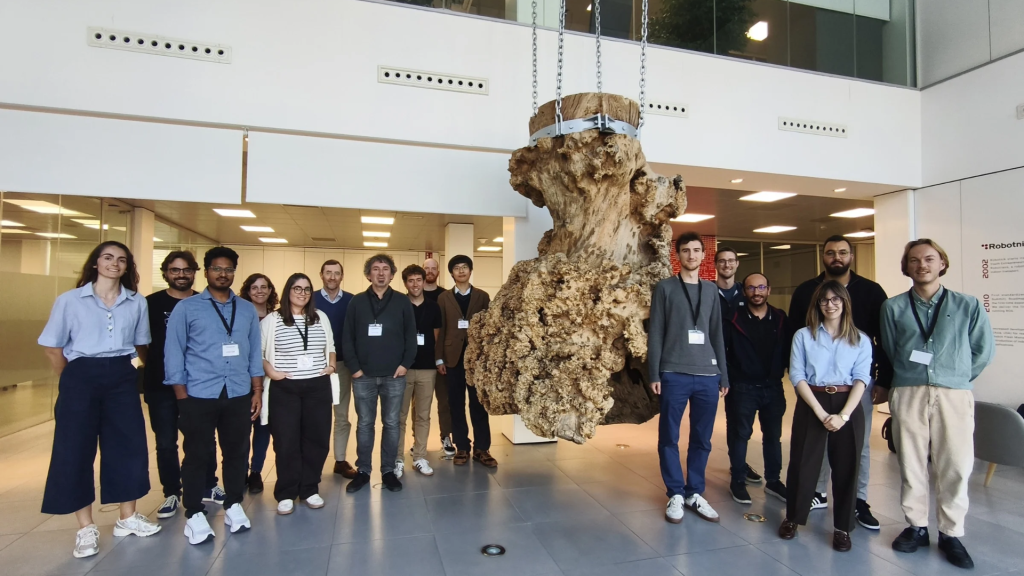
Consortium partners at the General Assembly, Robotnik facilities (Valencia, Spain) – October 2026
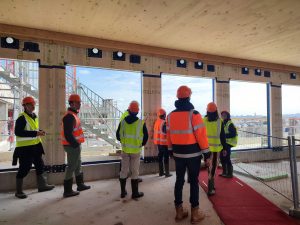
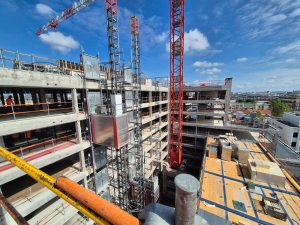
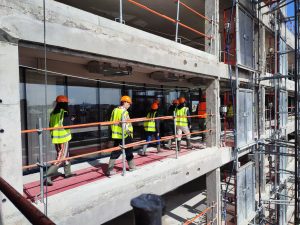
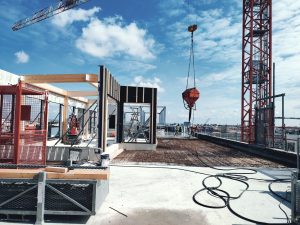
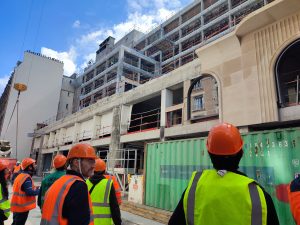
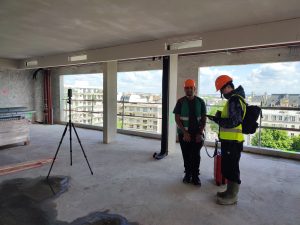
Our journey started at IDEKO’s premises in Elgoibar (Spain), where the partners held the kick-off meeting in November 2025. Three months later, the University of Nottingham hosted the first General Assembly at its Jubilee Campus in Nottingham (United Kingdom). During both meetings, the hosts organised visits to their facilities, where partners learnt more about their work and saw some of the technologies that will be built on in ShieldBot. In May 2026, Bouygues Construction welcomed the Consortium to Guyancourt and Neuilly-sur-Seine (France) for the second General Assembly. Bouygues organised a field visit to their renovation site, Les Arches du Carreau, where DFKI and RPTU scanned part of the building.
The visit we organised in Paris proved very important and was welcomed by all Consortium partners, as it helped everyone clearly understand the physical and organisational constraints of a typical large renovation site. It will help the consortium better adapt and design their robotos to cope with those aspects. – Christian de Nacquard, R&D Innovation Manager, Bouygues Construction
Consortium partners field visit to Bouygues renovation site, Les Arches du Carreau, (Guyancourt and Neuilly-sur-Seine, France)
As project coordinators, one of our main achievements has been keeping all partners involved and making sure that their activities are well aligned. There is a very good working atmosphere within the Consortium, with strong collaboration between partners. The project is now progressing with the design of the different solutions, and we hope to start turning these designs into prototypes during the second year. – Iker Mancisidor, Technical Manager, Dynamic & Control Department Engineer, IDEKO.
From Requirements to Designs: Progress on the ShieldBot Robots
ShieldBot works on three robotic solutions, each linked to a demo case. Bouygues Construction started the year by specifying what each robot needs to do on site, its functions, preliminary constraints, and KPI’s for the selected use cases.
InnerShieldBot
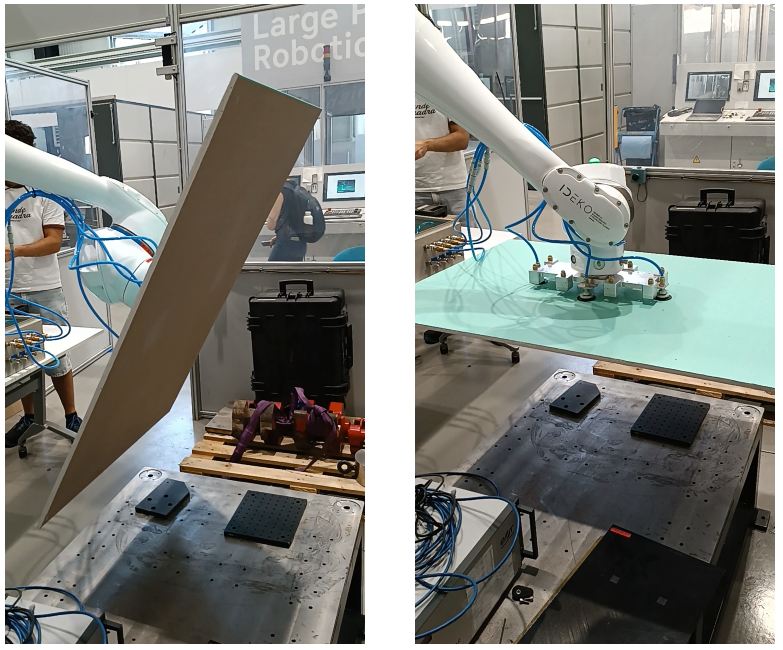
With InnerShieldBot, two robotic arms and a continuum robot will install thermal shielding on interior walls and ceilings in office buildings. At IDEKO, the team has been working in a robotic simulation environment to study how two robot arms can work together to hold and handle panels. They have analysed the reach of the arms and how accessible the panels are, and tested different configurations to find a design that meets the agreed requirements. In parallel, IDEKO is developing computer vision systems to make arm positioning more accurate during panel installation. Finding the right balance between reach, accessibility and payload has been the main challenge.
IDEKO’s robotic simulation with robotic arm to study how two robot arms can work together to hold and handle panels
The arms need a base to move around the site. Robotnik Automation has been working on adapting its RB-ROBOUT mobile platform to carry two collaborative industrial arms, along with the tools and actuators they need. Robotnik has also looked at mounting the snake robot developed by the University of Nottingham on its RB-VOGUI platform.
We are particularly proud of having defined an optimal, versatile mobile base configuration capable of accommodating both dual-arm manipulation and specialised payloads like the snake robot, along with their auxiliary tools. Achieving this balance between payload capacity, platform dimensions, and en-user operational needs marks a key milestone in ensuring that our robotic platforms can operate effectively in real construction environments. –March Bosch, Project Manager & Software Engineer, Robotnik Automation
That snake robot is the University of Nottingham’s central contribution to InnerShieldBot: a long, soft robotic arm with several degrees of freedom and adjustable stiffness, designed to reach confined spaces such as the gap behind ceiling panels and spray eco-friendly insulation material.
Inspection ShieldBot
InspectionShieldBot combines a drone and a crawling robot that use non-destructive testing to find hidden defects in façades without scaffolding or cranes. The University of Nottingham has been developing the crawling robot to inspect and perform minor maintenance on exterior façades. Their challenge is tough: keeping the robot moving fast, with low energy use, on vertical or even inverted surfaces while carrying high-precision sensors.
We developed novel concepts, built initial prototypes and demonstrated their feasibility. The snake robot developed for InnerShieldBot achieved a satisfactory pyload-to-weight ratio, arm stiffness and slenderness for operation in confined spaces while InspectionShieldBot demonstrated fast locomotion on vertical surfaces while carrying out façade scanning. – Xin Dong, Associate Professor, and Jung-Che Chang, Research Fellow, University of Nottingham
FaçadeShieldBot
The Façade ShieldBot, a cable-driven parallel robot (CDPR), will install prefabricated bio-based insulation panels on the façades of multi-family dwellings. The aim is to handle these panels without scaffolding.
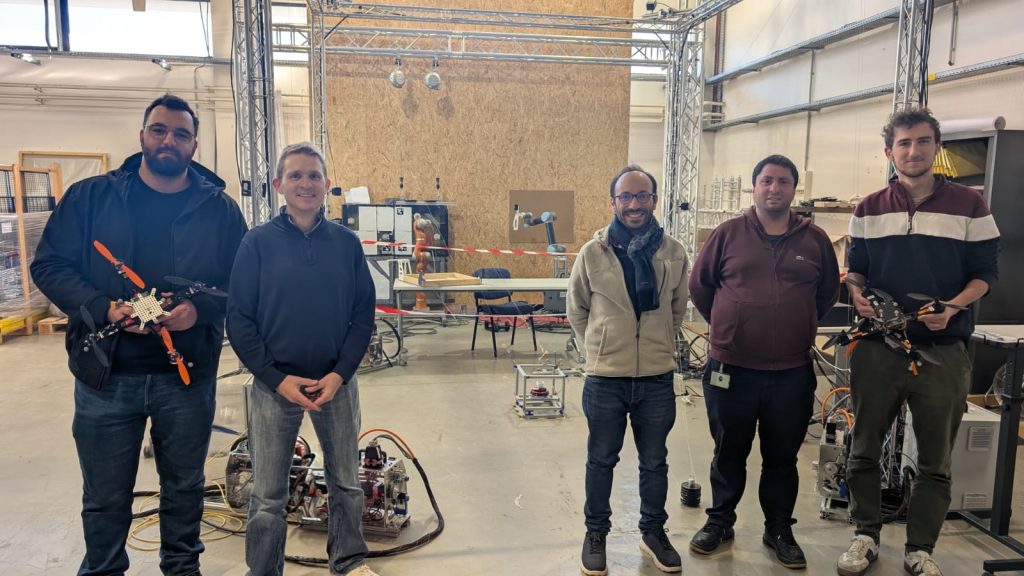
Nantes Université and CNRS are working on a compound system that links two types of robots. In an aerial cable-towed system (ACTS), a platform is connected to several drones by cables; in a CDPR, the platform is connected to winches. During the first year, the team developed several control laws for this combined ACTS-CDPR system.
ACTS are a type of robots in which an aerial platform is connected to several drones by cables. CDPRs are a class of robots in which a platform is connected to winches. During the first year, we developed several control laws for ACTS-CDPR system that we want to test experimentally during the second year of the project. – Kevin Subrin, Associate Professor and Researcher, Nantes Université and, Stéphane Caro, Researcher Manager, CNRS
IDEKO has also proposed an actuator for low-frequency vibration control. If vibrations become a problem when the cable-driven platform is working, this technology could be tested on FaçadeShieldBot.
Consortium partners from LS2N, UNAN and CNRS working on ACTS-CDPR system
EcoShield: Insulation Materials with Recycled Content
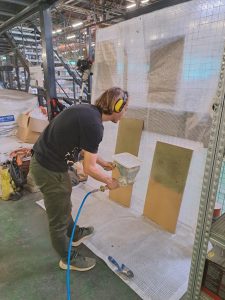
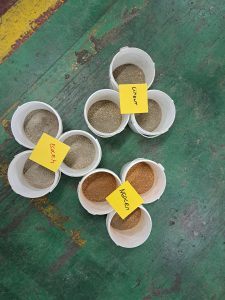
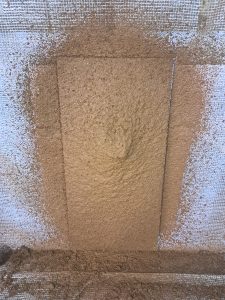
Neo-Eco is developing EcoShield, the sustainable insulation materials that ShieldBot’s robots will apply. This year, the team prepared its first material formulations and completed the first spray trials to check how well the materials can be pumped and how well they stick. The main difficulty was getting enough adhesion on vertical walls so that the material does not slide or fall off after it is applied.
We are particularly proud to have successfully developed and sprayed a material formulation containing over 90% recycled raw materials in its dry composition. This achievement represents an important milestone in demonstrating the technical feasibility of high-recycled-content mineral materials for spray application, while supporting our amgition to develop more sustainable and circular construction solutions. – Elodie Hubert, Circular Economy Project Manager, Neo-Eco
Neo-Eco first material spray trials to check its performance
DigiShield: Connecting Robots and Buildings Through Data
All three robots need a shared picture of the building they are working on. That is the role of DigiShield, the digital twin platform led by RPTU with DFKI.
Together, they published their Scan-to-BIM pipeline, BIMStruct3D, which turns 3D point clouds into IFC-compliant BIM models. Alongside the paper, RPTU also defined the first setup of the DigiShield platform. Choosing the right tools from the many available options was RPTU’s main challenge this year.
Setting up and connecting the data streams between the various ShieldBot solutions in a cohesive building model, including inspection data from the InspectionShieldBot and building representation data for the InnerShieldBot and FaçadeShieldBot, will be our major focus in year two, enabling seamless collaboration across al roboting systems.- Marius Schellen, M.Sc., Research Associate at the Institute of Concrete Structures and Structural Design, Civil Engineer, RPTU Kaiserslautern-Landau
DFKI has also been advancing its 3D open vocabulary pipelines, which allow robots to recognise objects without being limited to a fixed list of categories. These pipelines have already been tested on real ShieldBot data captured by RPTU and Bouygues Construction. Results were published in papers such as PanoSAMic and JOPP-3D.
The most important activity happening currently is bringing open-vocabulary scene understanding to the construction domain. This opens new perception possibiities for robotos and digitial twin/BIM generation without in-domain AI training and withouth the fixed-class vocabulary restriction. – Jason Rambach, Senior Researcher and Team Leader of the “Spatial Sensing and Machine Perception” group , DFKI
Building a Community Around ShieldBot
ShieldBot’s research has also travelled. In 2026, partners presented the project at renowned conferences, co-organised workshops and participated in joint events with cluster projects.
From the start, AUSTRALO set up ShieldBot’s communication channels and created its visual identity. Over the year, the project launched its website and social media, published its first two newsletters and started the ” Introducing the team behind ShieldBot interview series.
ShieldBot also joined the Tech4EUConstruction Cluster, a group of EU-funded projects working on technology for construction. Together, we organised workshops at ERF 2026 and ADRF26. With our sibling projects RADIANCE and RoboCons, we also wrote a joint article on how robotics, AI and intelligent automation can change Europe’s construction industry.
All partners have demonstrated a strong commitment to supporting ShieldBot’s communication and dissemiantion, recognising the importance of sharing its work, results and progress with the wider community. Their active involvement and willingness to contribute to different communication initiatives have been and will be essential for an effective outreach. – Jessica Carneiro, Project Manager, AUSTRALO Marketing Lab.
What Comes Next
Year 2 started in November 2026, and the focus is shifting from planning to implementation. IDEKO expects the first prototypes to be built from the current designs. Nantes University and CNRS will test their control laws on real systems. RPTU and DFKI will connect the data from the inspection robot and the building model in DigiShield, and keep working on linking IFC models with open-vocabulary perception.
Thank you to all ShieldBot partners for a first year of hard work and meaningful collaboration.