
media coverage
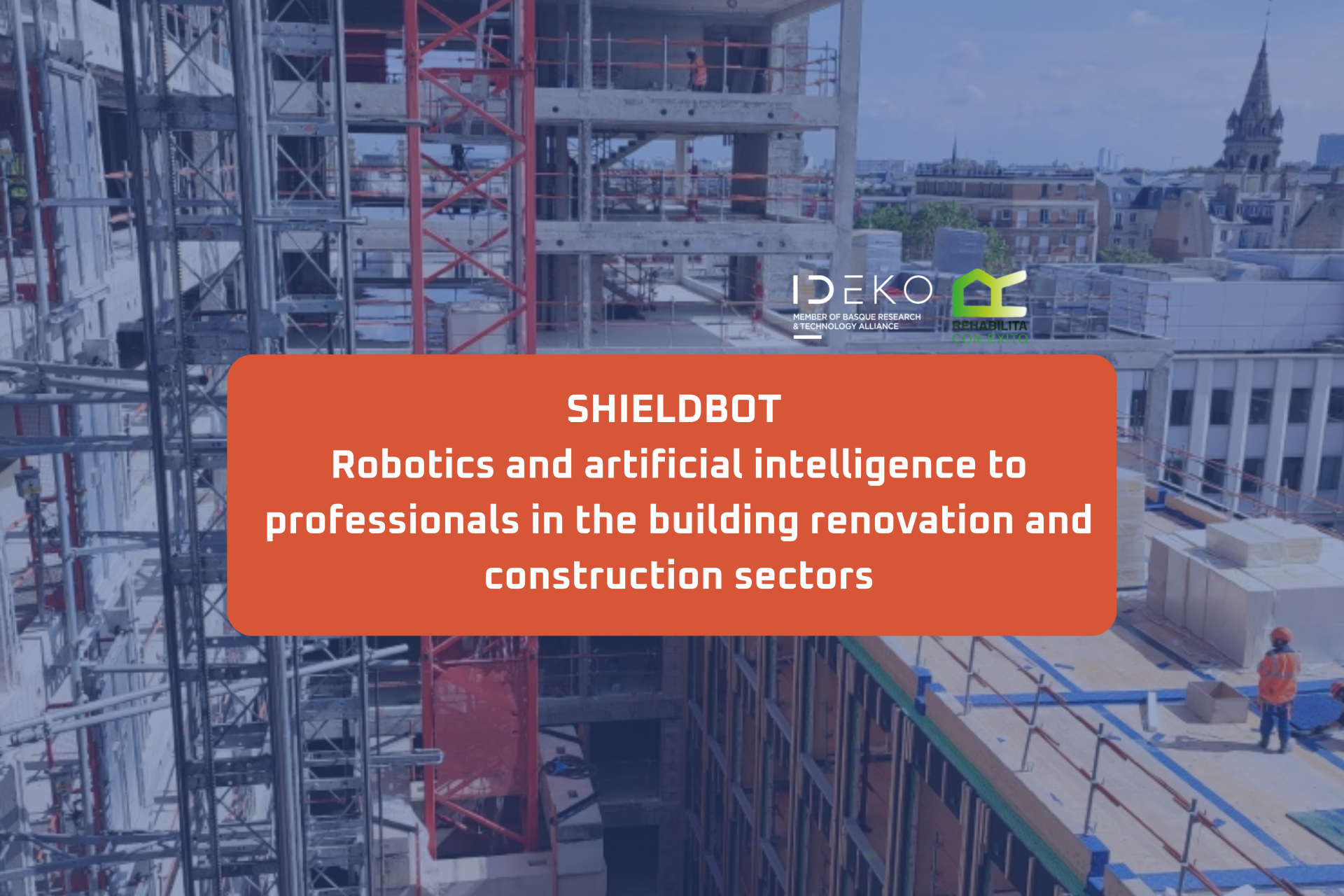
ShieldBot Featured in Spanish Sector Magazine Rehabilita con Éxito
On 16 October 2026, the Spanish sector magazine Rehabilita con Éxito published the article “Robótica para rehabilitar edificios” (“Robotics for renovating buildings”), featuring ShieldBot and its work on robotics and artificial intelligence (AI) for the energy renovation of buildings.
The article presents ShieldBot’s work on automated solutions to improve thermal insulation, increase worker safety and optimise interventions in existing buildings. It also highlights the role of IDEKO, ShieldBot’s project coordinator, in driving this European research and innovation initiative forward.
Below, we summarise the main points of the article:
Tackling the Barriers Facing Building Renovation
ShieldBot is funded by the European Union’s Horizon Europe programme and brings together eleven organisations from six countries. The project aims to overcome some of the main barriers the construction sector currently faces: high renovation costs, a shortage of skilled professionals and the need to carry out complex work in hazardous conditions.
The article describes energy renovation as one of the major challenges facing European construction. Citing data gathered by the project, it notes that buildings and the construction sector account for around 34% of global energy consumption and 37% of direct and indirect CO₂ emissions. In this context, automating certain tasks can help to accelerate the renovation of the building stock and improve the quality of interventions.
Intelligent Robots for Energy Efficiency
ShieldBot combines advanced robotics, AI and new sustainable materials to develop systems capable of carrying out insulation, inspection and assembly operations, both indoors and on façades.
As the article points out, our aim is not only to increase productivity, but also to reduce workers’ exposure to physically demanding or potentially dangerous tasks.
IDEKO Leads the Technological Development
The article highlights the role of IDEKO, which is responsible for the scientific and technical coordination of the project and contributes its expertise in mechatronics, machine dynamics, vibration control and advanced sensing.
One of the main challenges identified in the article is enabling robotic systems to operate in the changing, unstructured environments that characterise renovation sites. Unlike a factory, where working conditions are usually controlled, every building has its own geometry, obstacles and construction features.
For this reason, the researchers are working on robots that can adapt their behaviour to the real conditions of each intervention, while maintaining the stability and precision needed to place insulation panels or repair building envelopes.
Three Robotic Technologies for Building Renovation
ShieldBot plans to validate three technology platforms in real demonstrators over the three years of the project:
- Flexible robotics for interiors (InnerShieldBot): systems designed to facilitate assembly operations and improve the precision of the work.
- Drones and climbing robots for façades (InspectionShieldBot): combined solutions to inspect exterior surfaces and reach areas that are difficult to access.
- Cable-driven parallel robots (FaçadeShieldBot): devices designed to install external thermal insulation systems without the need for conventional scaffolding.
These technologies will be complemented by planning and management tools based on digital twins, Building Information Modelling (BIM) and AI algorithms. Combining these resources is intended to make interventions more coordinated, adaptable and efficient.
Sustainable Materials and Less Waste
ShieldBot’s innovation is not limited to automation. The project is also investigating the use of bio-based insulation materials and recycled products, with the aim of reducing the environmental impact of renovation work and supporting the circular economy.
Integrating these materials with robotic systems seeks to optimise their installation, reduce waste and move towards more sustainable ways of building. In this way, ShieldBot addresses energy efficiency from an integrated perspective that combines technology, materials and new working methods.
Towards Safer, More Precise and Automated Renovation
The article presents ShieldBot as a commitment to bringing technologies that are already transforming other industrial sectors into the building sector. Using robots to inspect façades, install insulation and carry out precision work opens up new opportunities to tackle complex interventions, reduce occupational risks and improve renovation processes.
The article also points out that these solutions still have to prove their effectiveness in real conditions, while noting that their development reflects a growing trend towards the digitalisation and automation of the sector. Validating the three platforms in real demonstrators is precisely the next step in ShieldBot’s work.
As the article puts it: “The renovation of the future will not depend solely on new materials or construction techniques, but also on the ability to incorporate intelligent technologies that make it possible to intervene in buildings in a more efficient, safe and sustainable way. With projects like ShieldBot, robotics is taking a new step towards its integration into energy renovation works.” (translated from Spanish)
Thank You, Rehabilita con Éxito
The ShieldBot consortium would like to thank Rehabilita con Éxito for featuring the project and for helping to raise awareness of the potential of robotics in sustainable building renovation.
🔗 Read the full article (in Spanish)
Photos: IDEKO (IDEKO website)
Follow our journey Join our newsletter