
Nantes Université is a French university that combines education and research across a wide range of fields, with around 42,000 students, 5,680 staff members, and 42 research laboratories. Its research spans fields from digital sciences and materials to thermal engineering and energy, and its international activity includes European research programmes and Erasmus+.
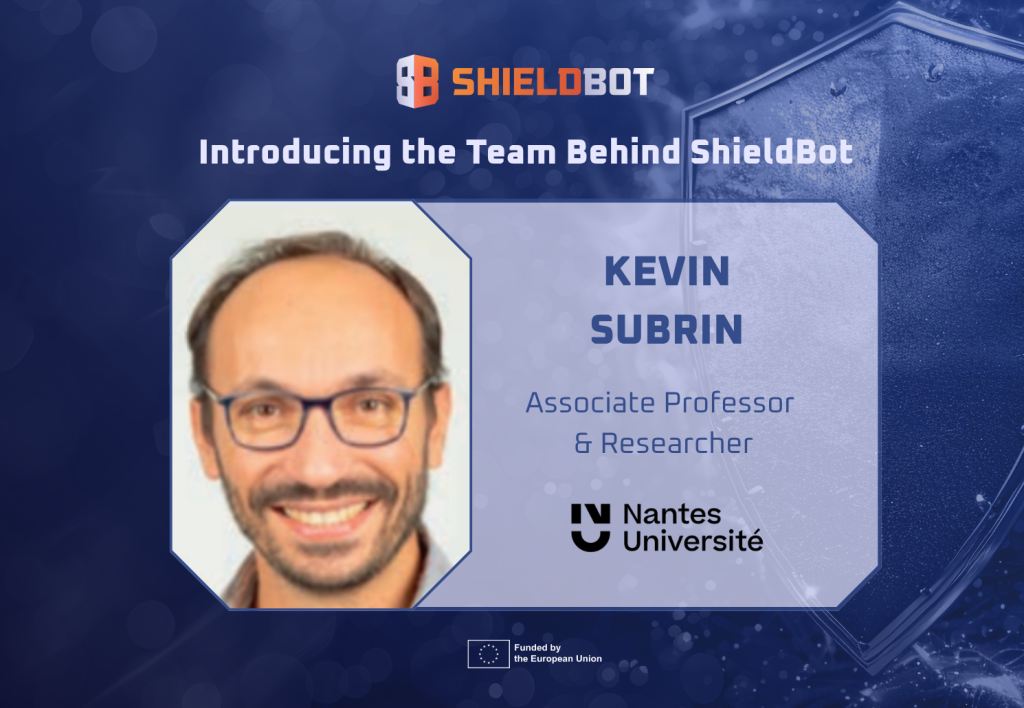
Kevin Subrin is an Associate Professor at Nantes Université. with his research activities conducted within LS2N. He holds an engineering degree in mechanical engineering and a PhD in industrial robotics.
Kevin’s work focuses on human-robot collaboration, with particular emphasis on improving robot performance. In ShieldBot, he leads Work Package 6, dedicated to prototype development. Within this work package, the team will develop the Façade ShieldBot, which will comprise two prototypes: a cable-driven parallel robot and an aerial cable-towed system combined with a cable-driven parallel robot, both intended to manipulate insulation panels on building façades.
”Nantes Université will bring its strong expertise in cable-driven parallel robots and, more recently, in aerial cable-towed systems. Insulation work on building façades often requires scaffolding, which is time-consuming to install and exposes workers to significant risks, including fatal falls.” Kevin Subrin, Associate Professor and Researcher at Nantes Université”
Why did you join ShieldBot?
Construction robotics is a key research area for our team. In 2017, we 3D-printed the Yhnova house, a project that subsequently led to the creation of Batiprint3D. In light of the scope of the call, our participation in this topic is highly relevant and particularly attractive to us.
What does Nantes Université bring to the project? Could you describe your role in ShieldBot?
Nantes Université will bring its strong expertise in cable-driven parallel robots and, more recently, in aerial cable-towed systems. Insulation work on building façades often requires scaffolding, which is time-consuming to install and exposes workers to significant risks, including fatal falls. Developing deployable robotic systems for façade insulation is therefore essential to improve safety on construction sites, support the renovation of buildings, and enhance indoor living conditions while addressing the challenges of the ecological transition.
What expectations do you have for the project from your personal/organisational perspective?
Our ambition is for the solution to be adopted by end users and successfully brought to market, thereby contributing to the acceleration of renovation.
Could you outline what you consider to be the three principal innovations that ShieldBot will develop over the course of the three-year project?
The project will deliver a set of robotic architectures capable of operating in both indoor and outdoor environments, as well as solutions to characterize the current energy performance of buildings. It will also provide key insights into how operators can be effectively integrated into the process, thereby supporting the acceptance and deployment of robotic solutions.
Which impact will ShieldBot have on industry and society in the short and long term?
In the short term, ShieldBot provides a credible pathway towards the ecological transition by supporting safer and more efficient building renovation. In the long term, ShieldBot will deliver a set of scalable robotic solutions that can accelerate the sustainable transformation of the construction sector.
How do you see the power of advanced robotics and sustainable practices transforming the European construction and energy building efficiency sector? What benefits can it bring to science, economy and society?
We need robust and accessible solutions that can benefit society as a whole. The world of tomorrow must aim for carbon neutrality and more controlled energy use, while relying on robotic systems to improve working conditions and support safer, more sustainable practices.