
Neo-Eco is a French company founded in 2008 that specialises in circular economy solutions and waste recovery, developing innovative methodologies to transform waste into reusable materials and reintegrate them into local economies. Working with a wide range of stakeholders, from municipalities and seaports to large manufacturers, the company helps reduce waste, landfill disposal, demand for virgin materials and CO₂ emissions through the recovery and valorisation of resources.
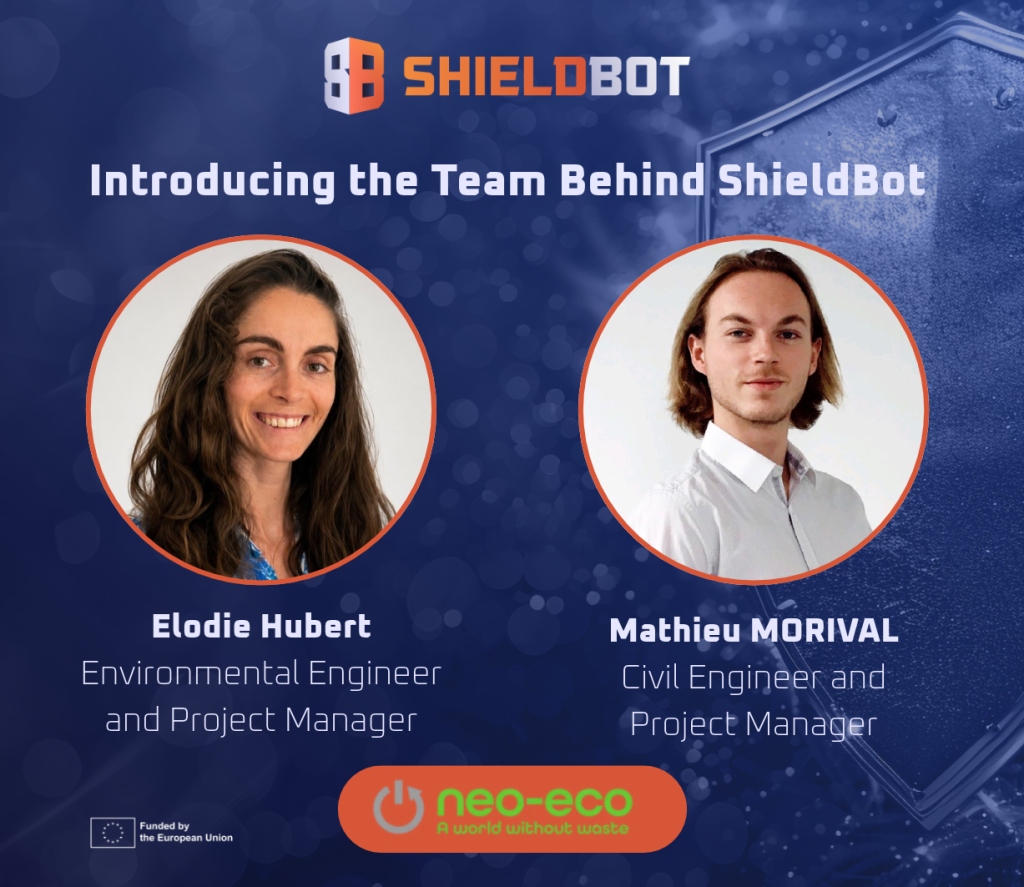
Mathieu Morival, Civil Engineer and Project Manager at Neo-Eco, and Elodie Hubert, Environmental Engineer and Project Manager at Neo-Eco, bring complementary expertise in construction material reuse, mineral waste recovery, eco-material development, life cycle assessment and eco-design. Within ShieldBot, they lead activities focused on integrating circular economy principles into robotic construction and identifying environmental constraints and opportunities. They also contribute to the development of sustainable insulation materials for exterior building façades, working on an eco-material that incorporates bio-based, geo-based and recycled components as alternatives to some virgin materials.
Neo-Eco’s vision is a world without waste; the Shieldbot project demonstrates that the circular economy can be integrated with innovation in the construction sector to enable faster, more cost-effective, and greener construction. We were immediately drawn to the project’s research and development aspect, as well as its interdisciplinary nature, which brings together IT, robotics, construction engineering, and materials science. – Elodie Hubert, Environmental Engineer and Project Manager and Mathieu Morival, Civil Engineer and Project Manager at Neo-Eco
Why did you join ShieldBot?
Neo-Eco’s vision is a world without waste; the ShieldBot project demonstrates that the circular economy can be integrated with innovation in the construction sector to enable faster, more cost-effective, and greener construction. We were immediately drawn to the project’s research and development aspect, as well as its interdisciplinary nature, which brings together IT, robotics, construction engineering, and materials science. Neo-Eco has been active in Ukraine since June 2022, and we felt that its methods of prefabrication and construction automation were particularly well-suited to the context of post-war reconstruction.
What does Neo-Eco and Neo-Eco Ukraine bring to the project? Could you describe your role in ShieldBot?
brings its expertise in materials engineering to the formulation of the insulation material. Neo-Eco Ukraine contributes its knowledge of the Ukrainian context, including its specific challenges and constraints, to explore the project’s scalability and potential integration into future reconstruction projects led by international donors.
What expectations do you have for the project from your personal/organisational perspective?
The project provides an opportunity to collaborate with top-level experts in innovative sectors. Our role is closely intertwined with that of Bouygues Construction, enabling us to envision close collaboration on the installation of the insulation and the scalability of its use to other demonstration buildings in France. Monitoring and understanding new innovations in robotics for construction are key factors for our future development.
Could you outline what you consider to be the three principal innovations that ShieldBot will develop over the course of the three-year project?
- Reducing the workforce required on a construction site (for building inspection, construction, or renovation) helps (especially in the Ukrainian context) to limit risks and safety concerns for workers
- To develop an eco-material that emits less CO2 than standard solutions, partially addresses the issue of construction waste management, and is suitable for robotic spraying (resulting in fewer losses, less spillage, and energy savings)
- To raise awareness among the value chain and construction industry stakeholders about new methods by demonstrating experimental prototypes
Which impact will ShieldBot have on industry and society in the short and long term?
In our part (eco-friendly insulation materials), Shieldbot’s strength lies in offering a more sustainable solution without requiring users to change their practices: same thermal resistance, same price, same installation requirements.
How do you see the power of advanced robotics and sustainable practices transforming the European construction and energy building efficiency sector? What benefits can it bring to science, economy and society?
There are many advantages; if we had to summarize just one, we would mention efficiency: efficiency in the duration of construction projects, in the rational use of materials, in the collection of traceability data, in the resilient design of buildings to address climate change, in planning for the end of a building’s life cycle, and in the traceability of materials, etc.