
RPTU is the Rheinland-Pfälzische Technische Universität, the only technical university in Rhineland-Palatinate, and a centre of international cutting-edge research and an academic talent factory for business and science. RPTU is also an innovation and transfer partner for politics, business and society.
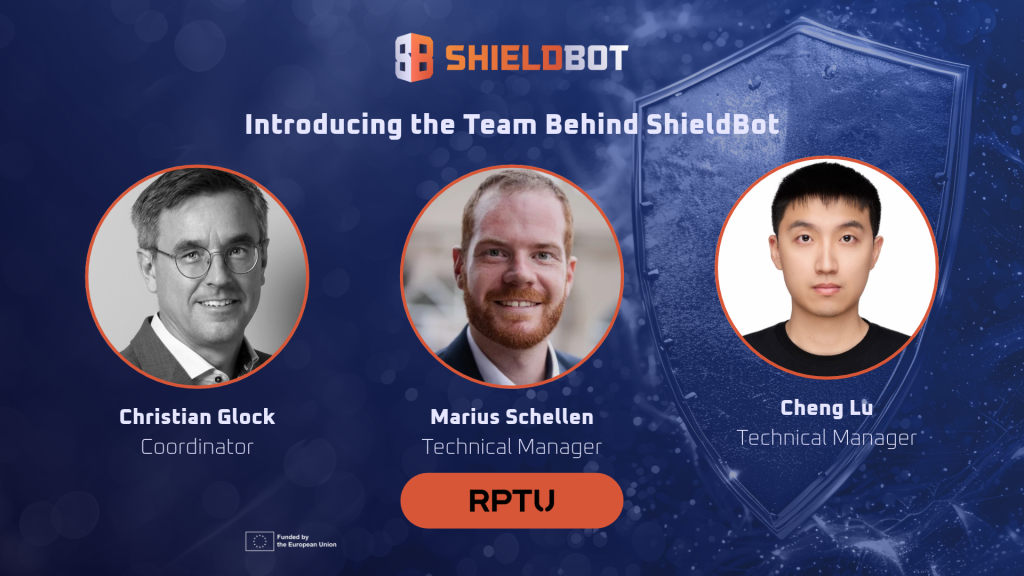
Prof. Dr.-Ing. Christian Glock, Professor of Concrete Structures and Structural Design at RPTU Kaiserslautern-Landau, Civil Engineer, formerly Managing Director and Executive Vice President at Bilfinger SE; Marius Schellen, M.Sc., Research Associate at the Institute of Concrete Structures and Structural Design, Civil Engineer; and Cheng Lu, M.Sc., Research Associate at the Institute of Concrete Structures and Structural Design, Civil Engineer. They work together at RPTU, and their main role within ShieldBot is to lead task T5.2, “Digital twin and dynamic BIM integration”, together with Deutsches Forschungszentrum für Künstliche Intelligenz (DFKI).
We are thrilled to be part of such a motivated and innovative consortium. Joining ShieldBot gives us a wonderful opportunity to take our research on digital BIM tools and structural engineering to a European level. While we have strong roots in the German construction sector, we really value the chance to look beyond our borders. It is incredibly important to us to expand our network and collaborate with inspiring researchers and fantastic facilities across Europe.
Why did you join ShieldBot?
Joining ShieldBot gave us a wonderful opportunity to take our research on digital BIM tools and structural engineering to a European level. While we have strong roots in the German construction sector, we really value the chance to look beyond our borders. Expanding our network and collaborating with inspiring researchers and excellent facilities across Europe is incredibly important to us.
What does RPTU bring to the project? Could you describe your role in ShieldBot?
For the development of our DigiShield solution, we are bringing a strong foundation to the ShieldBot project. We are contributing the intellectual property of a functional Scan-to-BIM pipeline, which we developed alongside DFKI in a previous collaboration within the HumanTech EU project. Right now, this system is focused on creating semantically enriched geometry models. Beyond this technical piece, we are excited to integrate our deep domain knowledge and our extensive network of German construction stakeholders. We can also provide a great mix of design and construction expertise that bridges long-term engineering practice with state-of-the-art research and top-tier laboratory facilities.
What expectations do you have for the project from your personal/organisational perspective?
Throughout this project, we really want to push our Scan to BIM pipeline further. Our goal is to integrate data from multiple sensors so we can automatically upgrade the building model into a true digital twin representation of existing structures. This developed model can then serve as the perfect foundation for automated robotic orchestration and orientation. We are also looking forward to working closely with DFKI again to enrich this pipeline with advanced AI tools. We are also genuinely excited to support the development of on-site construction robotics with our domain-specific insights. For us, this is a fantastic opportunity to learn from our partners across Europe and to share these experiences with our German interdisciplinary research initiative “Building the Future”, which we are proud to lead.
Could you outline what you consider to be the three principal innovations that ShieldBot will develop over the course of the three-year project?
For us, the most exciting innovations in the overall ShieldBot project are creating a fully integrated Scan to BIM pipeline. This will feature intuitive graphical interfaces and process data from multiple sensors via the InspectionShieldBot alongside smart AI orchestration for robotic tasks. Seeing the cable-driven FaçadeShieldBot in action and watching multiple robots work together seamlessly within the InnerShieldBot will be absolute highlights. These breakthroughs are exactly what is needed to bridge the gap between today’s manual processes and the automated future of construction.
What impact will ShieldBot have on industry and society in the short and long term?
In the short term, the ShieldBot solutions will likely have a moderate impact on the industry, as the expected Technology Readiness Level is still relatively low for the construction sector. However, we see ShieldBot as a vital project that establishes the foundational technology needed to scale up in the long run. With these solutions, the European construction sector will ultimately become more efficient, faster, safer, and more environmentally friendly.
How do you see the power of advanced robotics and sustainable practices transforming the European construction and energy building efficiency sector? What benefits can it bring to science, economy and society?
As one of the largest industries globally, the construction sector has a massive impact on our ecosystem, emissions and energy consumption. By integrating advanced robotic solutions with smart models of existing buildings, we have the opportunity to truly revolutionise the way we build. This approach will significantly lower emissions and resource consumption by focusing on revitalising existing structures instead of demolishing them to start from scratch. Furthermore, in a labour market facing a growing shortage of skilled workers, automated robotics can ease key bottlenecks and help deliver much-needed affordable housing across Europe.